Ch. 2 - Biochemistry Basics
Norman-McKay- Microbiology: Basic and Clinical Principles 2nd Edition
Norman-McKay2nd EditionMicrobiology: Basic and Clinical PrinciplesISBN: 9780137661619Not the one you use?Change textbook
Chapter 2, Problem 10

Complete the table:
Table with columns for biomolecule, basic components, and covalent linkage types, partially filled with examples.

Verified step by step guidance
1
Identify the biomolecule that forms glycosidic bonds between monomer units. Glycosidic bonds are characteristic of carbohydrates, so the first row corresponds to carbohydrates with basic components being monosaccharides (simple sugars).
For the second row, the biomolecule with glycerol and fatty acids as basic components and ester bonds as the covalent linkage is lipids (specifically triglycerides).
For RNA, determine its basic components. RNA is composed of nucleotides, which include a ribose sugar, phosphate group, and nitrogenous base. The covalent linkage between nucleotides in RNA is a phosphodiester bond.
For proteins, identify the basic components and the type of covalent bond. Proteins are made of amino acids linked by peptide bonds (also called amide bonds).
For the last row, where the basic components are nucleotides (dNTPs), this corresponds to DNA. The covalent linkage between nucleotides in DNA is also a phosphodiester bond.

Verified video answer for a similar problem:

This video solution was recommended by our tutors as helpful for the problem above.
Video duration:
1m
Was this helpful?

Key Concepts

Here are the essential concepts you must grasp in order to answer the question correctly.

Biomolecules and Their Basic Components

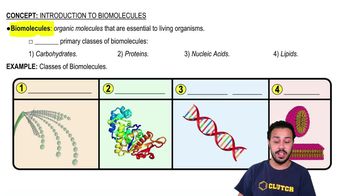
Biomolecules are large molecules essential for life, composed of smaller units called monomers. For example, carbohydrates are made of monosaccharides, lipids of glycerol and fatty acids, nucleic acids of nucleotides, and proteins of amino acids. Understanding these basic components helps identify the structure and function of each biomolecule.
Recommended video:
Guided course
01:22
Introduction to Biomolecules

Types of Covalent Linkages Between Monomers

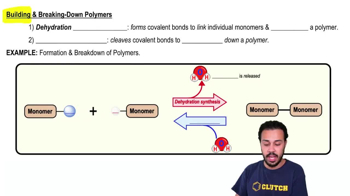
Monomers in biomolecules are linked by specific covalent bonds: glycosidic bonds connect sugar units in carbohydrates, ester bonds link glycerol and fatty acids in lipids, phosphodiester bonds join nucleotides in nucleic acids, and peptide bonds link amino acids in proteins. Recognizing these bonds is crucial for understanding biomolecular structure.
Recommended video:
Guided course
04:19
Building & Breaking-Down Polymers

Nucleotides and Their Role in RNA and DNA

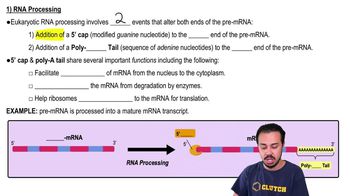
Nucleotides, composed of a sugar, phosphate group, and nitrogenous base, are the monomers of nucleic acids like RNA and DNA. RNA contains ribonucleotides, while DNA contains deoxyribonucleotides (dNTPs). These nucleotides are linked by phosphodiester bonds to form the backbone of nucleic acid strands.
Recommended video:
Guided course
04:19
1) RNA Processing