Ch. 8 - Microbial Metabolism
Norman-McKay- Microbiology: Basic and Clinical Principles 2nd Edition
Norman-McKay2nd EditionMicrobiology: Basic and Clinical PrinciplesISBN: 9780137661619Not the one you use?Change textbook
Chapter 8, Problem 9

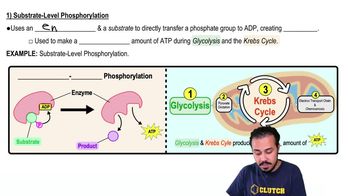
_______________________ is a process that relies on a phosphorylated intermediate to directly convert ADP to ATP.

Verified step by step guidance
1
Identify the key concept in the question: it asks for a process that uses a phosphorylated intermediate to directly convert ADP to ATP.
Recall that ATP synthesis can occur through different mechanisms, such as substrate-level phosphorylation and oxidative phosphorylation.
Understand that substrate-level phosphorylation involves the direct transfer of a phosphate group from a phosphorylated intermediate to ADP, forming ATP.
Contrast this with oxidative phosphorylation, which uses a proton gradient and ATP synthase rather than a phosphorylated intermediate.
Conclude that the process described in the question is substrate-level phosphorylation.

Verified video answer for a similar problem:

This video solution was recommended by our tutors as helpful for the problem above.
Video duration:
4m
Was this helpful?

Key Concepts

Here are the essential concepts you must grasp in order to answer the question correctly.

Substrate-Level Phosphorylation

Substrate-level phosphorylation is a metabolic process where a phosphate group is directly transferred from a phosphorylated intermediate to ADP, forming ATP. This mechanism occurs in glycolysis and the Krebs cycle and does not require oxygen or an electron transport chain.
Recommended video:
Guided course
03:00
Substrate-Level Phosphorylation

Phosphorylated Intermediate

A phosphorylated intermediate is a molecule temporarily bonded to a phosphate group during metabolic reactions. It serves as a high-energy donor that transfers the phosphate to ADP, enabling ATP synthesis without involving oxidative phosphorylation.
Recommended video:
Guided course
01:06
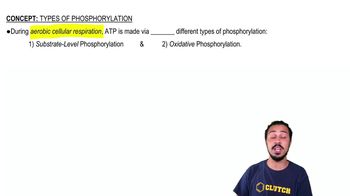
Types of Phosphorylation

ATP Synthesis Mechanisms

ATP can be synthesized via substrate-level phosphorylation or oxidative phosphorylation. Understanding these mechanisms helps distinguish how cells generate energy under different conditions, with substrate-level phosphorylation being a direct and oxygen-independent process.
Recommended video:
Related Practice
Textbook Question

Why do human cells require oxygen? Select all relevant statements.

a. To carry out glycolysis

b. To carry out fermentation

c. To carry out cellular respiration

d. To oxidize fats

e. To carry out substrate-level phosphorylation

f. To carry out oxidative phosphorylation

g. To carry out photophosphorylation

1125
views
Textbook Question

_______________________ is a process that uses light energy to drive an electron transport chain to make ATP.

1425
views
Textbook Question

The _______________________ test detects if an organism can convert hydrogen peroxide to water and oxygen. The test result is usually _______________________ in anaerobic microbes and usually _______________________ in aerobic microbes. You know the test is positive by _______________________.

1417
views
1
rank
Textbook Question

Draw and then fill out a Venn diagram (see sample version here) that compares and contrasts anaerobic respiration to aerobic respiration. The middle section of the diagram is where you should list the features these processes have in common. Include as many details as possible in this diagram to make this a useful exercise.

1226
views
Textbook Question

_______________________ is a process that uses energy from nutrients to fuel an electron transport chain to make ATP.

1378
views
Textbook Question

Indicate which statements about fermentation are true, and then correct the false statements.

a. Fermentation is an anaerobic process that can be used by prokaryotic or eukaryotic cells.

b. Sugars are the only nutrients that can be fermented.

c. Fermentation is a low ATP yielding process.

d. There are only five types of fermentation: homolactic, heterolactic, alcohol, mixed acid, and butanediol fermentation.

e. Fermentation is the same as anaerobic respiration.

1142
views