Ch. 2 - Biochemistry Basics
Norman-McKay- Microbiology: Basic and Clinical Principles 2nd Edition
Norman-McKay2nd EditionMicrobiology: Basic and Clinical PrinciplesISBN: 9780137661619Not the one you use?Change textbook
Chapter 2, Problem 7

Indicate the true statements and then correct the false statements so that they are true.
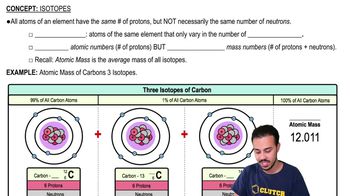
a. Isotopes are atoms with differing numbers of protons and the same number of neutrons.
b. A cation is a positive ion.
c. Redox reactions create ions.
d. Equal sharing of electrons leads to polar covalent bonds.
e. Ions are charged atoms.
f. CO2 is an inorganic molecule.
g. Isomers have the same molecular formula but different structures.
h. Adding a base to a solution will decrease the pH.

Verified step by step guidance
1
Step 1: Analyze statement (a): "Isotopes are atoms with differing numbers of protons and the same number of neutrons." Recall that isotopes are atoms of the same element that have the same number of protons but differ in the number of neutrons. So, identify the error and correct it accordingly.
Step 2: Review statement (b): "A cation is a positive ion." Confirm that this is true because cations are positively charged ions formed by the loss of electrons.
Step 3: Examine statement (c): "Redox reactions create ions." Understand that redox (reduction-oxidation) reactions involve the transfer of electrons, which can result in the formation of ions, but not all redox reactions necessarily create ions. Clarify this concept and correct the statement if needed.
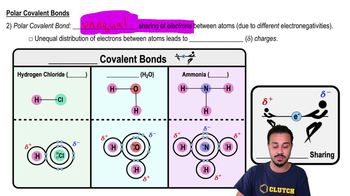
Step 4: Consider statement (d): "Equal sharing of electrons leads to polar covalent bonds." Recall that equal sharing of electrons results in nonpolar covalent bonds, while unequal sharing leads to polar covalent bonds. Correct the statement to reflect this.
Step 5: For statements (e) through (h), verify each: (e) "Ions are charged atoms." This is true. (f) "CO2 is an inorganic molecule." This is true because CO2 lacks carbon-hydrogen bonds. (g) "Isomers have the same molecular formula but different structures." This is true. (h) "Adding a base to a solution will decrease the pH." This is false because adding a base increases pH; correct this statement accordingly.

Verified video answer for a similar problem:

This video solution was recommended by our tutors as helpful for the problem above.
Video duration:
2m
Was this helpful?

Key Concepts

Here are the essential concepts you must grasp in order to answer the question correctly.

Atomic Structure and Isotopes

Atoms consist of protons, neutrons, and electrons. Isotopes are variants of the same element that have the same number of protons but different numbers of neutrons, affecting atomic mass but not chemical properties.
Recommended video:

Chemical Bonds and Polarity

Chemical bonds form when atoms share or transfer electrons. Covalent bonds involve sharing electrons; if sharing is equal, the bond is nonpolar, while unequal sharing creates polar covalent bonds with partial charges.
Recommended video:
Guided course
06:59
Polar Covalent Bonds

Acid-Base Chemistry and pH

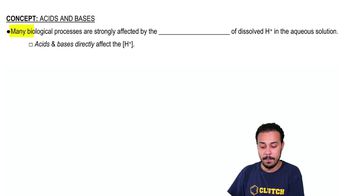
pH measures the acidity or basicity of a solution. Adding a base decreases hydrogen ion concentration, increasing pH, while adding an acid increases hydrogen ions, lowering pH. Bases do not decrease pH.
Recommended video:
Guided course
01:29
Acids and Bases