
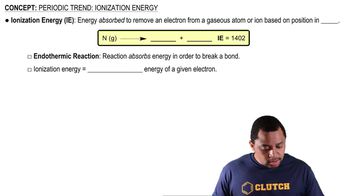
Write equations that show the processes that describe thefirst, second, and third ionization energies of a chlorineatom. Which process would require the least amount ofenergy?
Verified step by step guidance
Verified video answer for a similar problem:
Key Concepts
Ionization Energy
Chlorine Atom and Its Electron Configuration
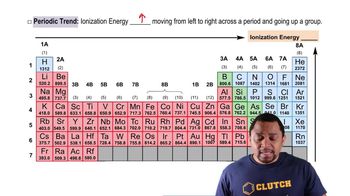
Trends in Ionization Energies
In the ionic compounds LiF, NaCl, KBr, and RbI, the measured cation–anion distances are 201 pm (Li–F), 282 pm (Na–Cl), 330 pm (K–Br), and 367 pm (Rb–I), respectively. (b) Calculate the difference between the experimentally measured ion–ion distances and the ones predicted from Figure 7.8.
Which element has the highest second ionization energy: Li, K, or Be?
In the ionic compounds LiF, NaCl, KBr, and RbI, the measured cation–anion distances are 201 pm (Li–F), 282 pm (Na–Cl), 330 pm (K–Br), and 367 pm (Rb–I), respectively. (c) What estimates of the cation– anion distance would you obtain for these four compounds using neutral atom bonding atomic radii? Are these estimates as accurate as the estimates using ionic radii?
Provide a brief explanation for each of the following: (a) Cl- is larger than Ar. (b) P3- is larger than S2-. (c) K+ is larger than Na+. (d) F- is larger than F.
