
Textbook Question
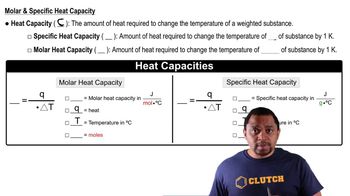
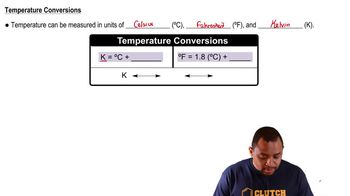
(a) What amount of heat (in joules) is required to raise the temperature of 1 g of water by 1 kelvin? (b) What amount of heat (in joules) is required to raise the temperature of 1 mole of water by 1 kelvin?

 Verified step by step guidance
 02:19
02:19
 02:03
02:03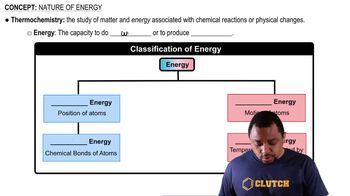 01:26
01:26(a) What amount of heat (in joules) is required to raise the temperature of 1 g of water by 1 kelvin? (b) What amount of heat (in joules) is required to raise the temperature of 1 mole of water by 1 kelvin?
Two solid objects, A and B, are placed in boiling water and allowed to come to the temperature of the water. Each is then lifted out and placed in separate beakers containing 1000 g of water at 10.0 °C. Object A increases the water temperature by 3.50 °C; B increases the water temperature by 2.60 °C. (b) What can you say about the specific heats of A and B?
The specific heat of octane, C8H18(l), is 2.22 J•g/K. (b) Which will require more heat, increasing the temperature of 1 mol of C8H18(l), by a certain amount or increasing the temperature of 1 mol of H2O(l) by the same amount?
The specific heat of octane, C8H18(l), is 2.22 J•g/K. (a) How many J of heat are needed to raise the temperature of 80.0 g of octane from 10.0 to 25.0 °C?
Consider the data about gold metal in Exercise 5.26(b). (a) Based on the data, calculate the specific heat of Au(s).
(d) How many kJ of heat are needed to raise the temperature of 5.00 kg of liquid water from 24.6 to 46.2 °C?