An electron in the n = 7 level of the hydrogen atom relaxes to a lower-energy level, emitting light of 397 nm. What is the value of n for the level to which the electron relaxed?
Ch.7 - Quantum-Mechanical Model of the Atom
Chapter 7, Problem 74
The human eye contains a molecule called 11-cis-retinal that changes shape when struck with light of sufficient energy. The change in shape triggers a series of events that results in an electrical signal being sent to the brain that results in vision. The minimum energy required to change the conformation of 11-cis-retinal within the eye is about 164 kJ/mol. Calculate the longest wavelength visible to the human eye.
Verified step by step guidance1
First, we need to understand that the energy of a photon is given by the equation E = h*c/λ, where E is the energy, h is Planck's constant (6.626 x 10^-34 J*s), c is the speed of light (3.00 x 10^8 m/s), and λ is the wavelength.
Next, we need to convert the energy given in the problem from kJ/mol to J/photon. We know that 1 mol of photons contains Avogadro's number (6.022 x 10^23) of photons. So, we multiply the given energy by 1000 to convert from kJ to J, and then divide by Avogadro's number to convert from mol to individual photons.
Then, we substitute the energy value obtained in the previous step into the equation E = h*c/λ. We rearrange the equation to solve for λ, which gives us λ = h*c/E.
Now, we substitute the values of h, c, and E into the equation to calculate the wavelength. Remember to keep the units consistent.
Finally, the wavelength obtained will be in meters. To convert it to nanometers (which is a more common unit for wavelength), multiply the result by 1 x 10^9.

Verified video answer for a similar problem:
This video solution was recommended by our tutors as helpful for the problem above.
Was this helpful?
Key Concepts
Here are the essential concepts you must grasp in order to answer the question correctly.
Energy and Wavelength Relationship
The energy of a photon is inversely related to its wavelength, described by the equation E = hc/λ, where E is energy, h is Planck's constant, c is the speed of light, and λ is the wavelength. This relationship indicates that higher energy photons correspond to shorter wavelengths, while lower energy photons correspond to longer wavelengths.
Recommended video:
Guided course
Frequency-Wavelength Relationship
Visible Spectrum
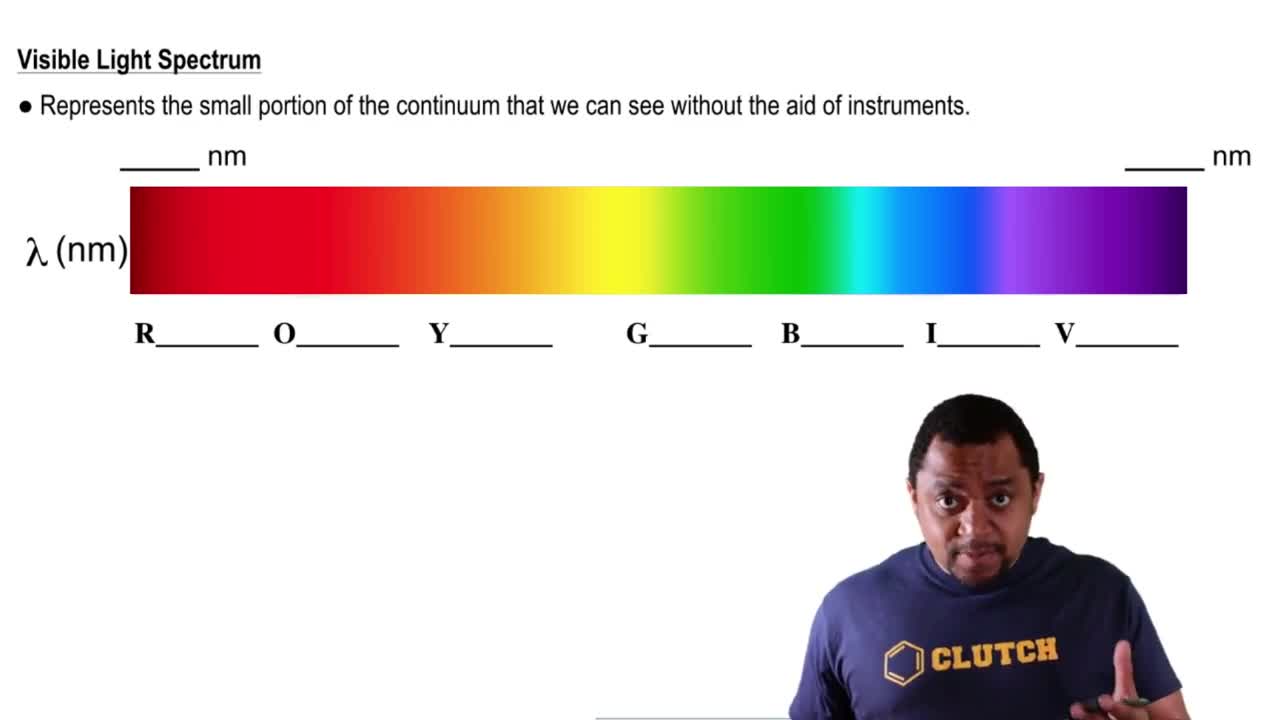
The visible spectrum is the portion of the electromagnetic spectrum that can be detected by the human eye, typically ranging from about 380 nm (violet) to 750 nm (red). Understanding this range is crucial for determining the longest wavelength that can still trigger the conformational change in 11-cis-retinal, which is essential for vision.
Recommended video:
Guided course
Visible Light Spectrum
Conformational Change in Molecules
Conformational change refers to the alteration in the shape of a molecule due to external stimuli, such as light. In the case of 11-cis-retinal, the absorption of a photon with sufficient energy causes it to change from a cis to a trans configuration, initiating a biochemical cascade that ultimately leads to vision.
Recommended video:
Guided course
Chemical Changes
Related Practice
Textbook Question
8548
views
5
rank
2
comments
Textbook Question
According to the quantum-mechanical model for the hydrogen atom, which electron transition produces light with the longer wavelength: 3p → 2s or 4p → 3p?
1091
views
2
comments
Textbook Question
An argon ion laser puts out 5.0 W of continuous power at a wavelength of 532 nm. The diameter of the laser beam is 5.5 mm. If the laser is pointed toward a pinhole with a diameter of 1.2 mm, how many photons travel through the pinhole per second? Assume that the light intensity is equally distributed throughout the entire cross-sectional area of the beam. (1 W = 1 J/s)
1009
views
Textbook Question
Calculate the frequency of the light emitted when an electron in a hydrogen atom makes each transition: a. n = 4 → n = 3 b. n = 5 → n = 1 c. n = 5 → n = 4 d. n = 6 → n = 5
8404
views
1
rank