
Indicate whether each of the following statements is true or false. For each statement that is false, correct the statement to make it true. (a) In general, the acidity of binary acids increases from left to right in a given row of the periodic table. (b) In a series of acids that have the same central atom, acid strength increases with the number of hydrogen atoms bonded to the central atom. (c) Hydrotelluric acid 1H2Te2 is a stronger acid than H2S because Te is more electronegative than S.
Ch.16 - Acid-Base Equilibria
Brown14th EditionChemistry: The Central ScienceISBN: 9780134414232Not the one you use?Change textbook
Chapter 16, Problem 90b
Based on their compositions and structures and on conjugate acid–base relationships, select the stronger base in each of the following pairs: (b) PO43- or AsO43-
Verified step by step guidance1
Identify the conjugate acids of the given bases: HPO4^{2-} for PO4^{3-} and HAsO4^{2-} for AsO4^{3-}.
Compare the acid strengths of HPO4^{2-} and HAsO4^{2-}. The weaker the conjugate acid, the stronger the base.
Consider the position of phosphorus (P) and arsenic (As) in the periodic table. Elements in the same group often have similar properties, but acidity can vary based on electronegativity and atomic size.
Phosphorus is above arsenic in the periodic table, which generally means HPO4^{2-} is a weaker acid than HAsO4^{2-} due to the smaller size and higher electronegativity of phosphorus.
Conclude that PO4^{3-} is the stronger base because its conjugate acid, HPO4^{2-}, is weaker than the conjugate acid of AsO4^{3-}.

Verified video answer for a similar problem:
This video solution was recommended by our tutors as helpful for the problem above.
Video duration:
3mWas this helpful?
Key Concepts
Here are the essential concepts you must grasp in order to answer the question correctly.
Conjugate Acid-Base Pairs
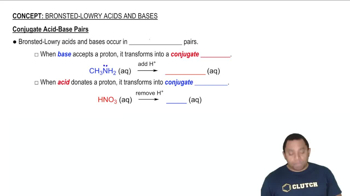
Conjugate acid-base pairs consist of two species that differ by the presence of a proton (H+). When an acid donates a proton, it forms its conjugate base, while a base that accepts a proton forms its conjugate acid. Understanding these relationships is crucial for determining the strength of acids and bases, as stronger bases have weaker conjugate acids.
Recommended video:
Guided course
Conjugate Acid-Base Pairs
Base Strength and Stability
The strength of a base is influenced by its ability to accept protons and the stability of the resulting conjugate acid. A more stable conjugate acid indicates a stronger base, as it is less likely to donate a proton back. Factors affecting stability include electronegativity, resonance, and the size of the atom holding the negative charge.
Recommended video:
Guided course
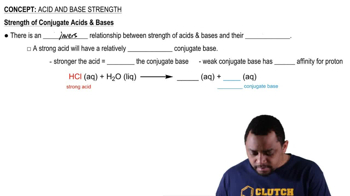
Strength of Conjugate Acids and Bases
Comparative Analysis of Anions
When comparing anions like PO4^3- and AsO4^3-, it is essential to consider their atomic structure and electronegativity. The central atom's size and electronegativity affect the anion's ability to stabilize the negative charge. Generally, larger atoms can better accommodate negative charges, influencing the relative strength of the bases formed by these anions.
Recommended video:
Guided course
Dimensional Analysis
Related Practice
Textbook Question
603
views
Textbook Question
Based on their compositions and structures and on conjugate acid–base relationships, select the stronger base in each of the following pairs: (b) BrO- or BrO2-
929
views
Textbook Question
Indicate whether each of the following statements is true or false. For each statement that is false, correct the statement to make it true. (a) Acid strength in a series of H¬A molecules increases with increasing size of A. (b) For acids of the same general structure but differing electronegativities of the central atoms, acid strength decreases with increasing electronegativity of the central atom. (c) The strongest acid known is HF because fluorine is the most electronegative element.
633
views
Textbook Question
Predict the stronger acid in each pair: (e) benzoic acid (C6H5COOH) or phenol (C6H5OH).
1167
views
