NaCl and KF have the same crystal structure. The only difference between the two is the distance that separates cations and anions. (b) Use the ionic radii given in Figure 7.8 to estimate the Na─Cl and K─F distances.
Ch.8 - Basic Concepts of Chemical Bonding
Brown14th EditionChemistry: The Central ScienceISBN: 9780134414232Not the one you use?Change textbook
Chapter 8, Problem 22a
NaCl and KF have the same crystal structure. The only difference between the two is the distance that separates cations and anions. (a) The lattice energies of NaCl and KF are given in Table 8.1. Based on the lattice energies, would you expect the Na─Cl or the K─F distance to be longer?
Verified step by step guidance1
Identify the relationship between lattice energy and ionic distance. Lattice energy is inversely proportional to the distance between ions; the greater the distance, the lower the lattice energy.
Look up the lattice energies for NaCl and KF in Table 8.1. Compare the values to determine which compound has the higher lattice energy.
Based on the comparison, determine which compound has the shorter ionic distance. The compound with the higher lattice energy will have the shorter distance between ions.
Conclude which ionic distance is longer based on the inverse relationship between lattice energy and ionic distance. If NaCl has a higher lattice energy than KF, then the Na─Cl distance is shorter, making the K─F distance longer, and vice versa.
Summarize the findings: The compound with the lower lattice energy will have the longer distance between its cations and anions.

Verified video answer for a similar problem:
This video solution was recommended by our tutors as helpful for the problem above.
Video duration:
2mWas this helpful?
Key Concepts
Here are the essential concepts you must grasp in order to answer the question correctly.
Lattice Energy
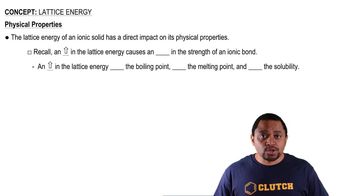
Lattice energy is the amount of energy released when gaseous ions combine to form an ionic solid. It is a measure of the strength of the forces between the ions in an ionic compound. Higher lattice energy indicates stronger ionic bonds, which typically results in shorter distances between cations and anions.
Recommended video:
Guided course
Lattice Energy
Ionic Radius
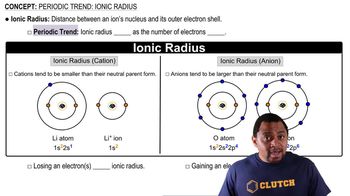
Ionic radius refers to the size of an ion in a crystal lattice. Cations are smaller than their parent atoms due to the loss of electrons, while anions are larger due to the gain of electrons. The size of the ions affects the distance between them in the lattice structure, influencing the overall lattice energy.
Recommended video:
Guided course
Ionic Radius
Coulomb's Law
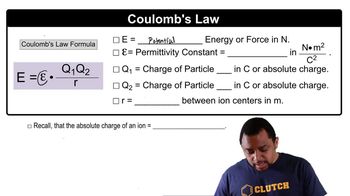
Coulomb's Law describes the electrostatic interaction between charged particles. It states that the force between two charged ions is directly proportional to the product of their charges and inversely proportional to the square of the distance between them. This principle helps explain how the distance between ions affects lattice energy and stability.
Recommended video:
Guided course
Coulomb's Law Concept 2
Related Practice
Textbook Question
545
views
Textbook Question
(a) Is lattice energy usually endothermic or exothermic?
1
views
Textbook Question
(b) Write the chemical equation that represents the process of lattice energy for the case of NaCl.
1771
views
Textbook Question
(c) Would you expect salts like NaCl, which have singly charged ions, to have larger or smaller lattice energies compared to salts like CaO which are composed of doubly-charged ions?
472
views
Textbook Question
The substances NaF and CaO are isoelectronic (have the same number of valence electrons). (b) What are the charges of each of the anions in each compound?
403
views
Textbook Question
The substances NaF and CaO are isoelectronic (have the same number of valence electrons). (c) Without looking up lattice energies, which compound is predicted to have the larger lattice energy?