
Consider the Lewis structure for acetic acid, which is known as vinegar: (b) What are the hybridizations of the orbitals on the two oxygen atoms, and what are the approximate bond angles at the oxygen that is connected to carbon and hydrogen? What are the hybridizations of the orbitals on the two oxygen atoms?
Ch.9 - Molecular Geometry and Bonding Theories
Brown14th EditionChemistry: The Central ScienceISBN: 9780134414232Not the one you use?Change textbook
Chapter 9, Problem 63
(c) Is the p bond in NO2- localized or delocalized?
Verified step by step guidance1
Step 1: Understand the concept of localized and delocalized bonds. A localized bond is a bond that is confined between two atoms. A delocalized bond, on the other hand, is a bond in which the electrons are not confined to two adjacent bonding atoms, but actually spread over three or more atoms.
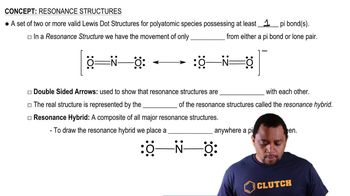
Step 2: Draw the Lewis structure of NO2-. The Lewis structure of NO2- (Nitrite ion) is a resonance structure. It consists of nitrogen (N) bonded to two oxygen (O) atoms. One of the oxygen atoms has a single bond with nitrogen and the other oxygen atom has a double bond with nitrogen. However, these bonds keep switching between the two oxygen atoms, creating a resonance structure.
Step 3: Identify the p bond in the structure. In the Lewis structure of NO2-, the p bond is the second bond in the double bond between the nitrogen and one of the oxygen atoms.
Step 4: Determine whether the p bond is localized or delocalized. Since the double bond in NO2- is part of a resonance structure and can switch between the two oxygen atoms, the p bond is not confined to just two atoms. Therefore, the p bond in NO2- is delocalized.

Verified video answer for a similar problem:
This video solution was recommended by our tutors as helpful for the problem above.
Video duration:
5mWas this helpful?
Key Concepts
Here are the essential concepts you must grasp in order to answer the question correctly.
Bonding in Molecules
In molecular chemistry, bonding refers to the interactions that hold atoms together in a molecule. There are two primary types of bonds: localized bonds, where electrons are shared between specific atoms, and delocalized bonds, where electrons are spread over multiple atoms. Understanding these concepts is crucial for analyzing the structure and stability of molecules like NO2-.
Recommended video:
Guided course
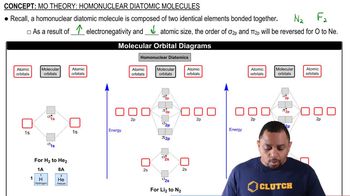
Homonuclear Diatomic Molecules
Resonance Structures
Resonance structures are different ways of drawing a molecule that can represent the same arrangement of atoms but differ in the distribution of electrons. In the case of NO2-, resonance indicates that the p bond can be represented as being shared between the nitrogen and both oxygen atoms, suggesting that the bond is delocalized rather than confined to a single pair of atoms.
Recommended video:
Guided course
Resonance Structures
Molecular Orbital Theory
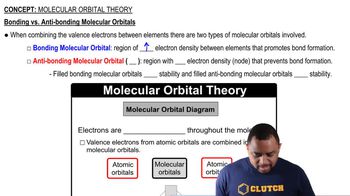
Molecular Orbital Theory explains how atomic orbitals combine to form molecular orbitals, which can be occupied by electrons. This theory helps in understanding the nature of bonding in molecules, including whether bonds are localized or delocalized. In NO2-, the presence of degenerate molecular orbitals allows for the delocalization of p electrons, contributing to the overall stability of the ion.
Recommended video:
Guided course
Molecular Orbital Theory
Related Practice
Textbook Question
963
views
Textbook Question
Consider the Lewis structure for glycine, the simplest amino acid:
(b) What are the hybridizations of the orbitals on the two oxygens and the nitrogen atom, and what are the approximate bond angles at the nitrogen?
420
views
Textbook Question
(c) Would you expect N2O to exhibit delocalized p bonding?
475
views
Textbook Question
(a) Write a single Lewis structure for N2O, and determine the hybridization of the central N atom.
Textbook Question
Consider the Lewis structure for glycine, the simplest amino acid:
(c) What is the total number of s bonds in the entire molecule, and what is the total number of p bonds?
663
views
Textbook Question
In the sulphate ion, SO42-, the sulphur atom is the central atom with the other 4 oxygen atoms attached to it. (b) What hybridization is exhibited by the S atom?
