Recall the logarithmic property that states: \(\log_a b - \log_a c = \log_a \left( \frac{b}{c} \right)\), which allows us to combine the difference of two logs with the same base into a single log of a quotient.
Apply this property to the equation \(\log_2 (x+9) - \log_2 x = 1\) to rewrite it as \(\log_2 \left( \frac{x+9}{x} \right) = 1\).
Rewrite the logarithmic equation in its equivalent exponential form: \(\frac{x+9}{x} = 2^1\).
Simplify the right side to get \(\frac{x+9}{x} = 2\), then multiply both sides by \(x\) to clear the denominator, resulting in \(x + 9 = 2x\).
Solve the linear equation \(x + 9 = 2x\) by isolating \(x\), and then check the solution to ensure it does not make any logarithm argument negative or zero.
Verified video answer for a similar problem:
This video solution was recommended by our tutors as helpful for the problem above
Video duration:
3m
Play a video:
0 Comments
Key Concepts
Here are the essential concepts you must grasp in order to answer the question correctly.
Properties of Logarithms
Logarithmic properties, such as the subtraction rule log_b(A) - log_b(B) = log_b(A/B), allow simplification of expressions involving logs. This property is essential for combining or breaking down logarithmic terms to solve equations.
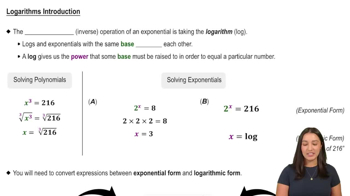
A logarithm log_b(A) answers the question: to what power must the base b be raised to get A? Understanding this helps convert logarithmic equations into exponential form, which is often easier to solve.
The argument of a logarithm must be positive, so expressions inside logs (like x and x+9) must be greater than zero. Recognizing domain restrictions ensures solutions are valid within the function's domain.

 3:44 minutes
 Verified step by step guidance
 5:36
5:36