Solve each logarithmic equation in Exercises 49–92. Be sure to reject any value of x that is not in the domain of the original logarithmic expressions. Give the exact answer. Then, where necessary, use a calculator to obtain a decimal approximation, correct to two decimal places, for the solution. log(x+4)−log 2=log(5x+1)
Ch. 4 - Exponential and Logarithmic Functions

Chapter 5, Problem 83
In Exercises 83–88, let logb 2 = A and logb 3 = C and Write each expression in terms of A and C.
logb (3/2)
Verified step by step guidance1
Recall the logarithm property for division: . This means the log of a quotient is the difference of the logs.
Substitute the given values: since and , replace these in the expression.
Write the expression as .
This expresses entirely in terms of the variables A and C as requested.
No further simplification is needed since the problem asks only to write the expression in terms of A and C.

Verified video answer for a similar problem:
This video solution was recommended by our tutors as helpful for the problem above.
Video duration:
1mWas this helpful?
Key Concepts
Here are the essential concepts you must grasp in order to answer the question correctly.
Properties of Logarithms
Logarithms have specific properties that simplify expressions, such as the quotient rule: log_b(x/y) = log_b(x) - log_b(y). This allows us to rewrite complex logarithmic expressions as differences or sums of simpler logs.
Recommended video:
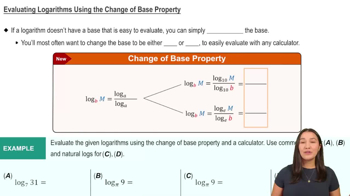
Change of Base Property
Change of Base and Logarithm Notation
Understanding the notation log_b(x) means the logarithm of x with base b is crucial. Given log_b(2) = A and log_b(3) = C, we can express other logarithms with base b in terms of A and C by applying logarithmic properties.
Recommended video:
Change of Base Property
Expressing Logarithmic Expressions in Terms of Variables
When given variables representing logarithms, such as A and C, the goal is to rewrite expressions like log_b(3/2) using these variables. This involves substituting and simplifying using known values and logarithmic rules.
Recommended video:
Guided course
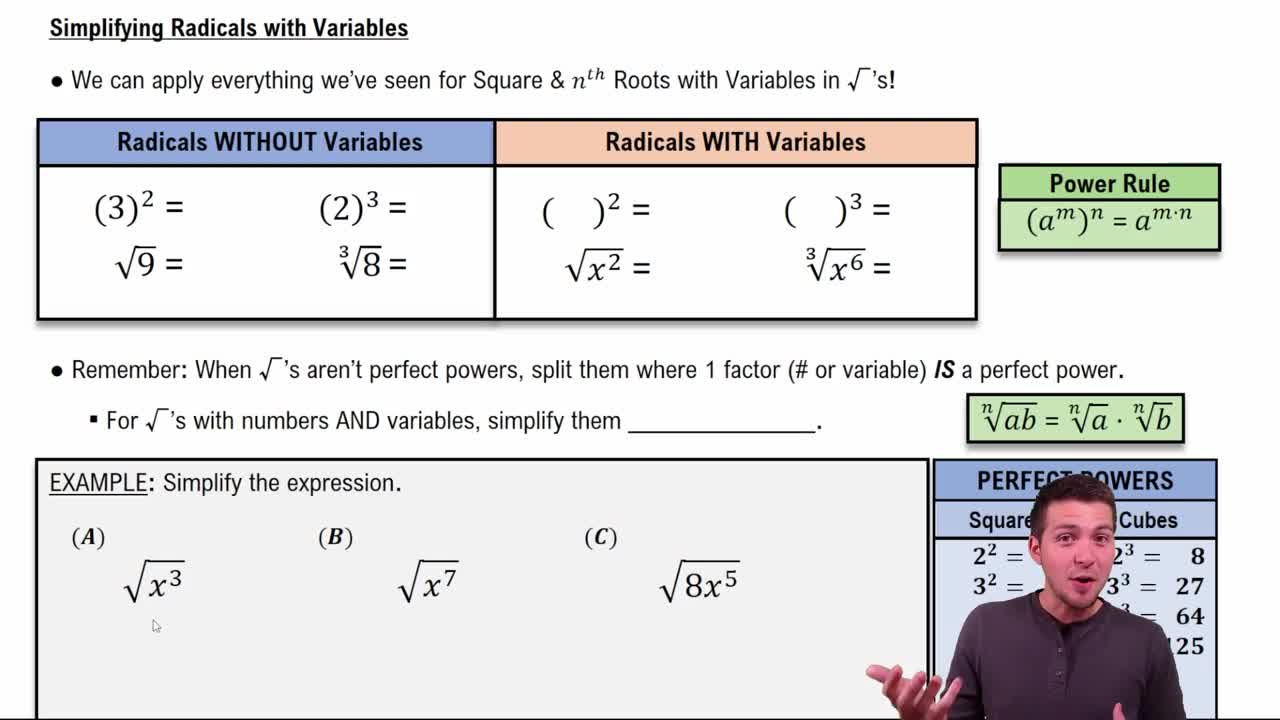
Radical Expressions with Variables
Related Practice
Textbook Question
1283
views
Textbook Question
Use the formula for continuous compounding to solve Exercises 84–85. How long, to the nearest tenth of a year, will it take \$50,000 to triple in value at an annual rate of 7.5% compounded continuously?
649
views
Textbook Question
Expand:
797
views
Textbook Question
Evaluate or simplify each expression without using a calculator. 10log 33
894
views
Textbook Question
Evaluate or simplify each expression without using a calculator. log 107
885
views
Textbook Question
Solve each logarithmic equation in Exercises 49–92. Be sure to reject any value of x that is not in the domain of the original logarithmic expressions. Give the exact answer. Then, where necessary, use a calculator to obtain a decimal approximation, correct to two decimal places, for the solution. 2 log x−log 7=log 112
814
views
