Ch. 4 - Inverse, Exponential, and Logarithmic Functions
Lial - College Algebra 13th Edition
Lial13th EditionCollege AlgebraISBN: 9780136881063Not the one you use?Change textbook
Chapter 5, Problem 91

Let u = ln a and v = ln b. Write each expression in terms of u and v without using the ln function. ln (b4 √a)

Verified step by step guidance
1
Start with the given expression: \(\ln \left(b^{4\sqrt{a}}\right)\).
Recall the logarithm power rule: \(\ln(x^k) = k \ln(x)\). Apply this to rewrite the expression as \(4\sqrt{a} \cdot \ln b\).
Express \(\sqrt{a}\) in terms of \(a\): \(\sqrt{a} = a^{1/2}\). So the expression becomes \(4 a^{1/2} \cdot \ln b\).
Since \(u = \ln a\) and \(v = \ln b\), rewrite \(a^{1/2}\) using the exponential and logarithm relationship: \(a^{1/2} = e^{(1/2) \ln a} = e^{(1/2) u}\).
Substitute back into the expression to get \(4 e^{(1/2) u} \cdot v\), which is the expression in terms of \(u\) and \(v\) without using the \(\ln\) function.

Verified video answer for a similar problem:

This video solution was recommended by our tutors as helpful for the problem above.
Video duration:
3m
Was this helpful?

Key Concepts

Here are the essential concepts you must grasp in order to answer the question correctly.

Properties of Logarithms

Logarithms have specific properties that simplify expressions, such as the power rule ln(x^r) = r ln(x) and the product rule ln(xy) = ln(x) + ln(y). These allow rewriting complex logarithmic expressions into sums and multiples of simpler logarithms.
Recommended video:
5:36
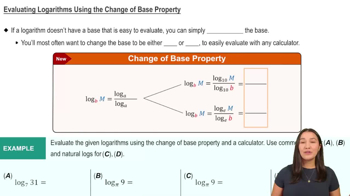
Change of Base Property

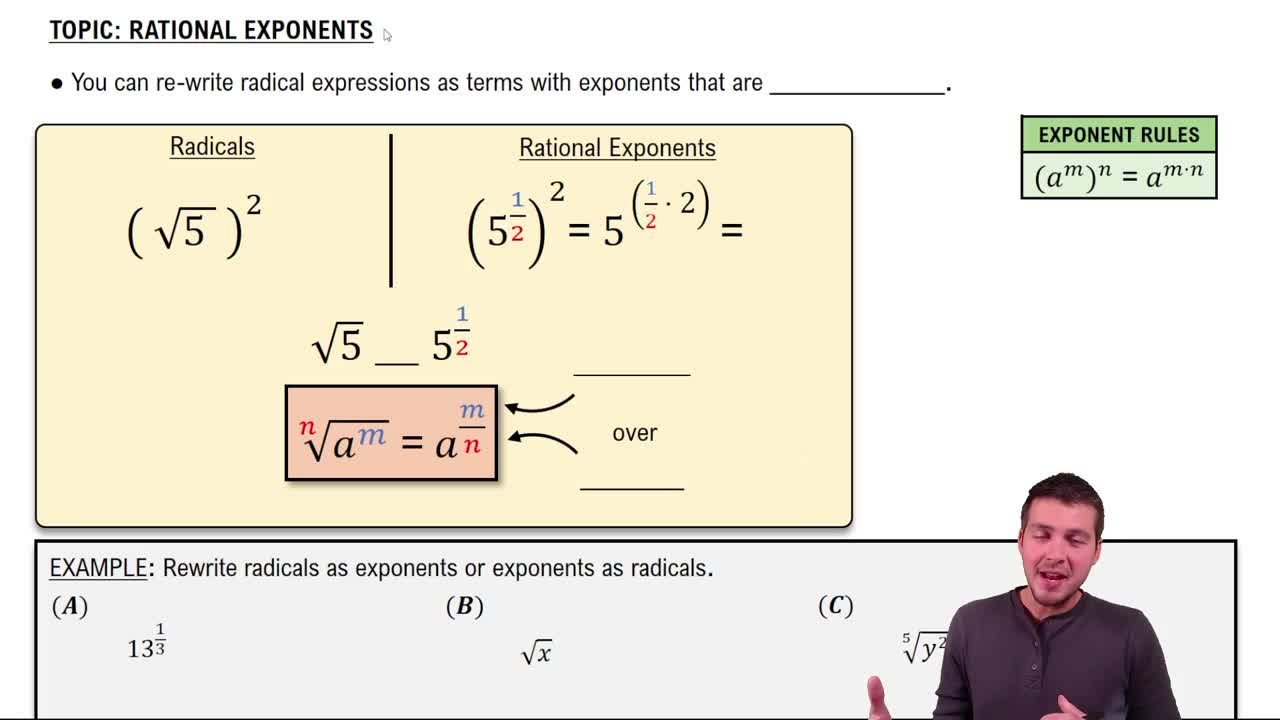
Exponent and Root Relationships

Roots can be expressed as fractional exponents, for example, the fourth root of a is a^(1/4). Understanding this allows rewriting expressions like b^4√a as b^4 * a^(1/4), facilitating the use of logarithm properties.
Recommended video:
Guided course
04:06
Rational Exponents

Substitution in Logarithmic Expressions

Given u = ln(a) and v = ln(b), substitution replaces ln(a) and ln(b) with u and v respectively. This helps express logarithmic expressions in terms of u and v without explicitly using the ln function.
Recommended video:
7:30
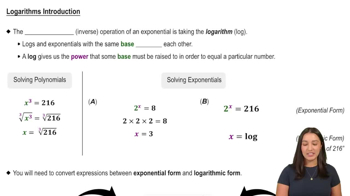
Logarithms Introduction