Use the graph to evaluate each expression. See Example 3(a). (ƒg)(0)
Verified step by step guidance
1
Understand that (ƒg)(0) means the composition of functions ƒ and g evaluated at 0, which is written as ƒ(g(0)).
First, find the value of g(0) by locating x = 0 on the g(x) graph (blue line) and reading the corresponding y-value.
Next, take the value found for g(0) and use it as the input for the function ƒ. This means you will find ƒ(g(0)) by locating x = g(0) on the ƒ(x) graph (red curve) and reading the corresponding y-value.
Write the expression for the composition: (ƒg)(0) = ƒ(g(0)) and substitute the values you found from the graph.
The final step is to interpret the y-value from the ƒ graph at x = g(0) as the result of (ƒg)(0).
Verified video answer for a similar problem:
This video solution was recommended by our tutors as helpful for the problem above
Video duration:
3m
Play a video:
0 Comments
Key Concepts
Here are the essential concepts you must grasp in order to answer the question correctly.
Function Composition
Function composition involves applying one function to the result of another, denoted as (f∘g)(x) = f(g(x)). To evaluate (f∘g)(0), first find g(0), then substitute that value into f. This process combines two functions into a single operation.
To evaluate functions using a graph, locate the input value on the x-axis and find the corresponding y-value on the function's curve. This y-value represents the function's output for that input. Accurate reading is essential for correct evaluation.
The graph shows f(x) as a quadratic function (parabola) and g(x) as a linear function (straight line). Recognizing their shapes helps in interpreting values and behavior, such as f(x) having a minimum point and g(x) increasing steadily.

 3:23 minutes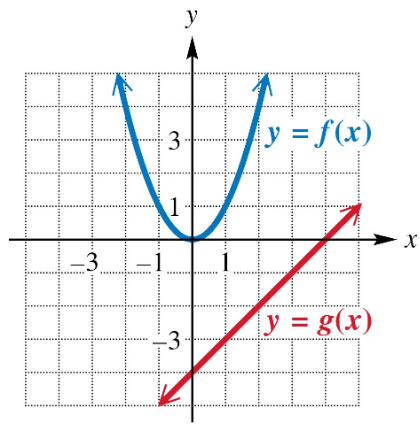
 Verified step by step guidance
 4:56
4:56