Use the graph to evaluate each expression. See Example 3(a). (ƒ/g)(2)
Verified step by step guidance
1
Identify the value of the functions f(x) and g(x) at x = 2 by locating the point where x = 2 on the x-axis and reading the corresponding y-values from the graph for both f(x) (red curve) and g(x) (blue line).
Write down the values you found: f(2) and g(2). These are the y-values of the red and blue graphs at x = 2, respectively.
Recall that the expression (ƒ/g)(2) means the value of the function f(x) divided by the value of the function g(x) at x = 2, which can be written as \(\frac{f(2)}{g(2)}\).
Substitute the values of f(2) and g(2) into the expression \(\frac{f(2)}{g(2)}\) to set up the division.
Make sure to check that g(2) is not zero before dividing, as division by zero is undefined.
Verified video answer for a similar problem:
This video solution was recommended by our tutors as helpful for the problem above
Video duration:
3m
Play a video:
0 Comments
Key Concepts
Here are the essential concepts you must grasp in order to answer the question correctly.
Function Evaluation
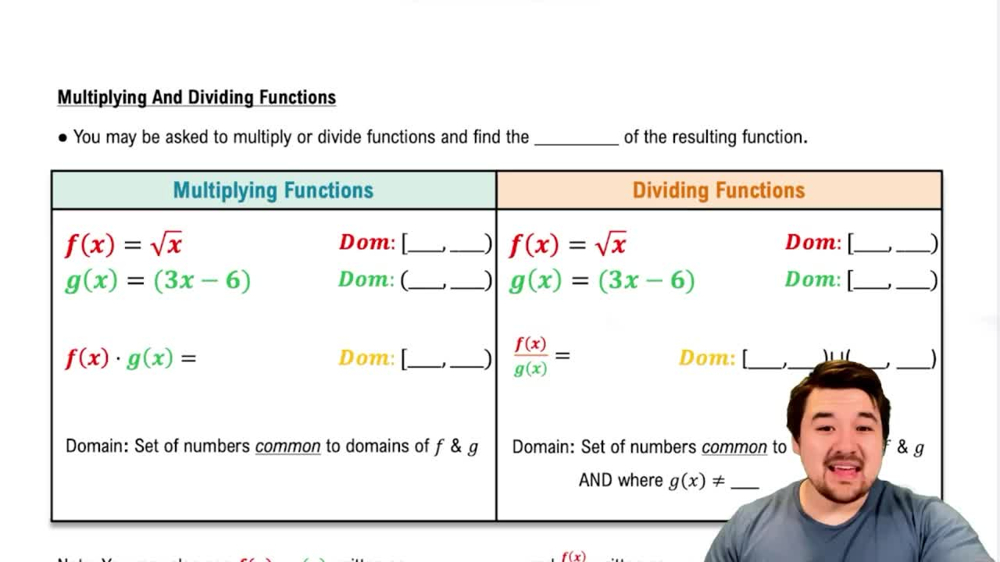
Function evaluation involves finding the output value of a function for a given input. For example, to evaluate f(2), locate x = 2 on the graph and find the corresponding y-value on the curve of f(x). This process applies to any function and is essential for understanding function behavior at specific points.
The division of two functions, denoted (f/g)(x), means dividing the value of f(x) by g(x) at the same input x. It is important to ensure g(x) ≠ 0 to avoid undefined expressions. This concept helps in combining functions and analyzing their ratios.
Reading graphs accurately is crucial for evaluating functions visually. Identify the input value on the x-axis, then trace vertically to the function curve to find the output on the y-axis. This skill allows you to estimate function values when algebraic expressions are not given.

 3:15 minutes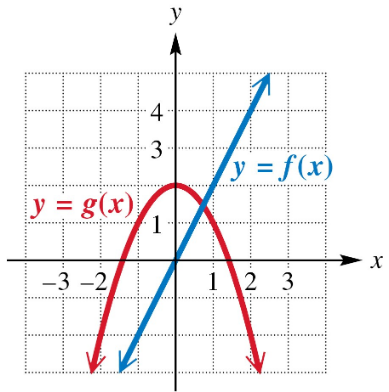
 Verified step by step guidance
 4:26
4:26