Use the graph to evaluate each expression. See Example 3(a). (ƒ+g)(0)
Verified step by step guidance
1
Identify the value of x at which you need to evaluate the expression. Here, it is x = 0.
Find the value of f(0) by locating the red curve (f(x)) on the graph at x = 0. Read the corresponding y-value on the vertical axis.
Find the value of g(0) by locating the blue curve (g(x)) on the graph at x = 0. Read the corresponding y-value on the vertical axis.
Add the two values together to find (f + g)(0), using the formula: \[(f + g)(0) = f(0) + g(0)\]
Write the final expression for (f + g)(0) using the values you found from the graph, but do not calculate the sum.
Verified video answer for a similar problem:
This video solution was recommended by our tutors as helpful for the problem above
Video duration:
3m
Play a video:
0 Comments
Key Concepts
Here are the essential concepts you must grasp in order to answer the question correctly.
Function Evaluation
Function evaluation involves finding the output value of a function for a given input. For example, to evaluate (f+g)(0), you find f(0) and g(0) separately and then add the results. This process is fundamental for understanding how functions behave at specific points.
The sum of two functions, (f+g)(x), is defined as f(x) + g(x). This means you add the output values of f and g for the same input x. Understanding function addition helps in combining different functions and analyzing their combined behavior.
Reading values from a graph requires identifying the coordinates of points on the function curves. To evaluate functions at x=0, locate x=0 on the x-axis and find the corresponding y-values on each graph. This skill is essential for interpreting graphical data and solving function-related problems.

 3:24 minutes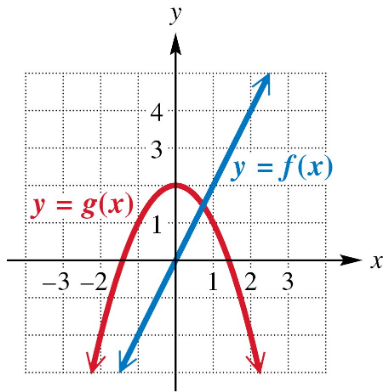
 Verified step by step guidance
 4:26
4:26