Recognize that the expression is in terms of the binomial \( (2y - 1) \). Let \( u = (2y - 1) \) to simplify the expression.
Rewrite the expression using \( u \): \( u^2 - 4u + 4 \).
Notice that \( u^2 - 4u + 4 \) is a quadratic trinomial. Check if it is a perfect square trinomial by comparing it to the form \( a^2 - 2ab + b^2 = (a - b)^2 \).
Since \( u^2 - 4u + 4 = (u - 2)^2 \), rewrite the expression back in terms of \( y \): \( ((2y - 1) - 2)^2 \).
Simplify inside the parentheses: \( (2y - 1 - 2)^2 = (2y - 3)^2 \). This is the factored form of the original expression.
Verified video answer for a similar problem:
This video solution was recommended by our tutors as helpful for the problem above
Video duration:
2m
Play a video:
0 Comments
Key Concepts
Here are the essential concepts you must grasp in order to answer the question correctly.
Recognizing Quadratic Expressions
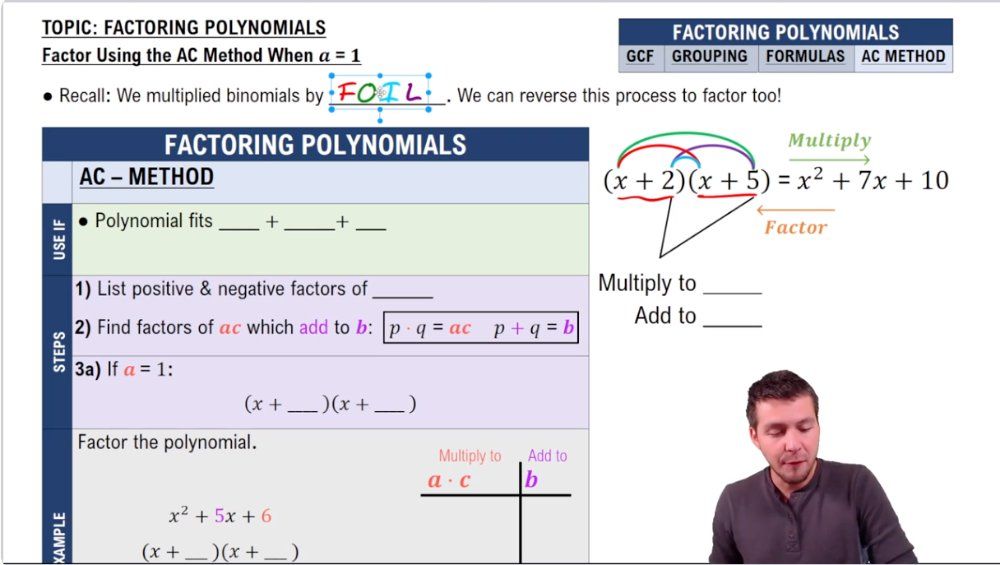
A quadratic expression is a polynomial of degree two, often in the form ax² + bx + c. In this problem, the expression is written in terms of a binomial (2y - 1), which can be treated as a single variable to simplify factoring.
Solving Quadratic Equations Using The Quadratic Formula
Substitution Method for Factoring
Substitution involves replacing a complex expression with a single variable to make factoring easier. Here, letting u = (2y - 1) transforms the expression into u² - 4u + 4, a standard quadratic that can be factored using familiar methods.
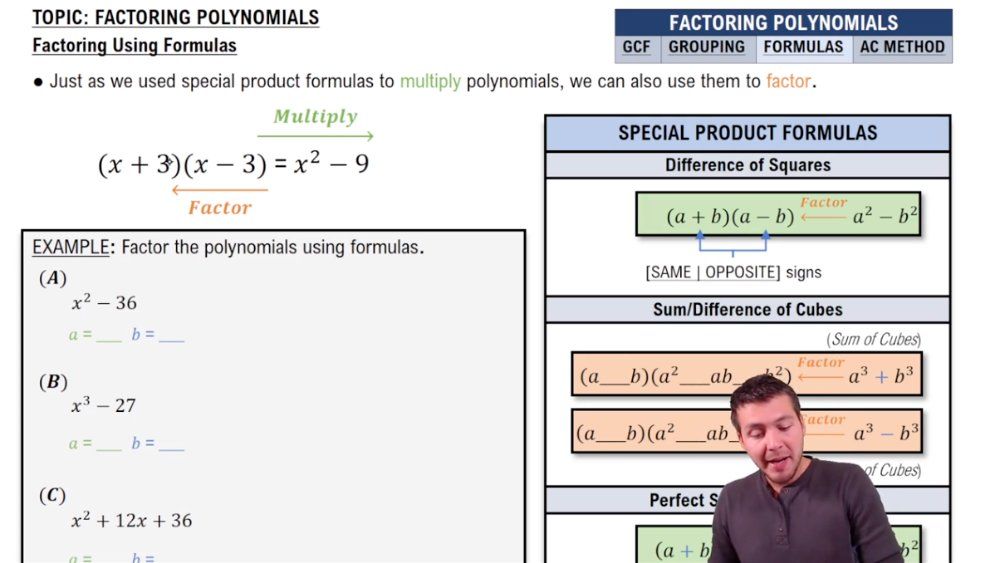
A perfect square trinomial is of the form a² - 2ab + b², which factors into (a - b)². Recognizing that u² - 4u + 4 fits this pattern allows quick factoring into (u - 2)², which can then be rewritten in terms of y.

 2:57 minutes
 Verified step by step guidance
 06:36
06:36