In Exercises 93–100, factor completely.x² + 0.3x − 0.04
Verified step by step guidance
1
Identify the quadratic equation in the form \( ax^2 + bx + c \), where \( a = 1 \), \( b = 0.3 \), and \( c = -0.04 \).
Use the quadratic formula \( x = \frac{-b \pm \sqrt{b^2 - 4ac}}{2a} \) to find the roots of the equation.
Calculate the discriminant \( b^2 - 4ac \) to determine if the roots are real and distinct, real and repeated, or complex.
If the discriminant is a perfect square, the quadratic can be factored using the roots found from the quadratic formula.
Express the quadratic as \( (x - r_1)(x - r_2) \) where \( r_1 \) and \( r_2 \) are the roots of the equation.
Verified video answer for a similar problem:
This video solution was recommended by our tutors as helpful for the problem above
Video duration:
3m
Play a video:
0 Comments
Key Concepts
Here are the essential concepts you must grasp in order to answer the question correctly.
Factoring Quadratic Expressions
Factoring quadratic expressions involves rewriting a quadratic in the form ax² + bx + c as a product of two binomials. This process is essential for solving equations and simplifying expressions. The goal is to express the quadratic in a form that reveals its roots or zeros, which can be found using methods like the quadratic formula or by inspection.
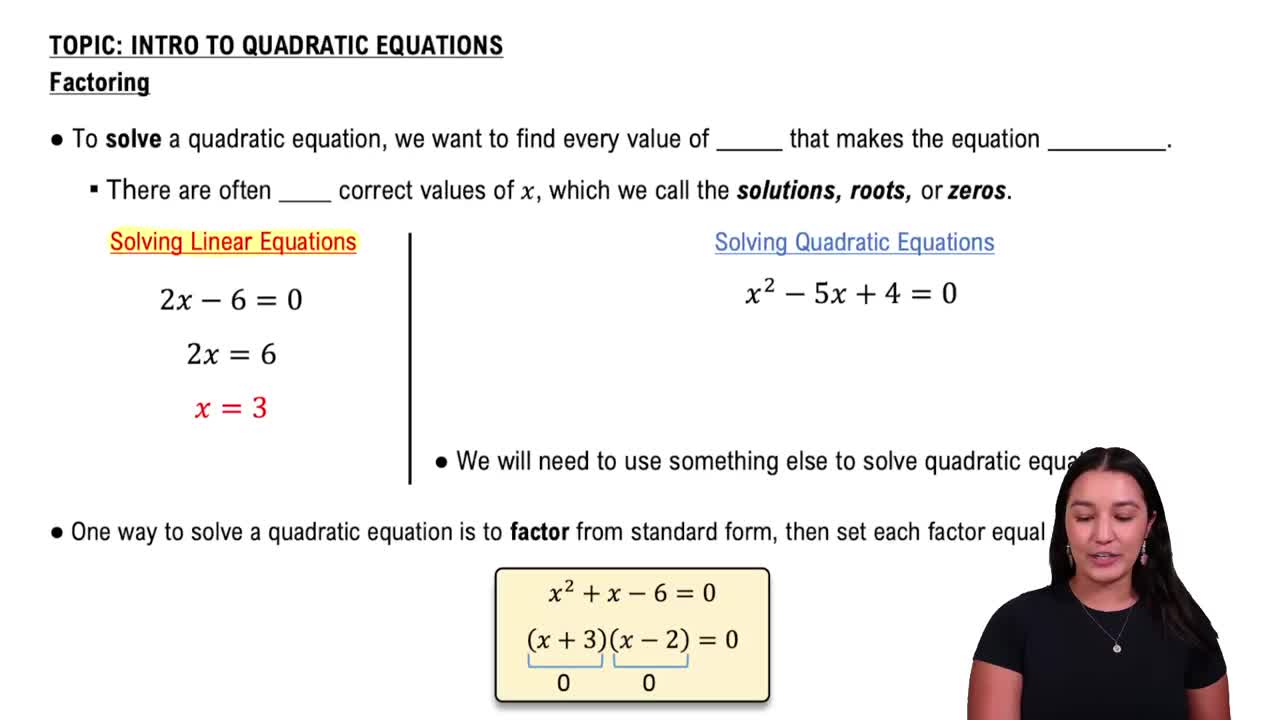
The Zero Product Property states that if the product of two factors equals zero, then at least one of the factors must be zero. This principle is crucial when solving quadratic equations after factoring, as it allows us to set each factor equal to zero to find the solutions. Understanding this property is fundamental for solving equations in algebra.
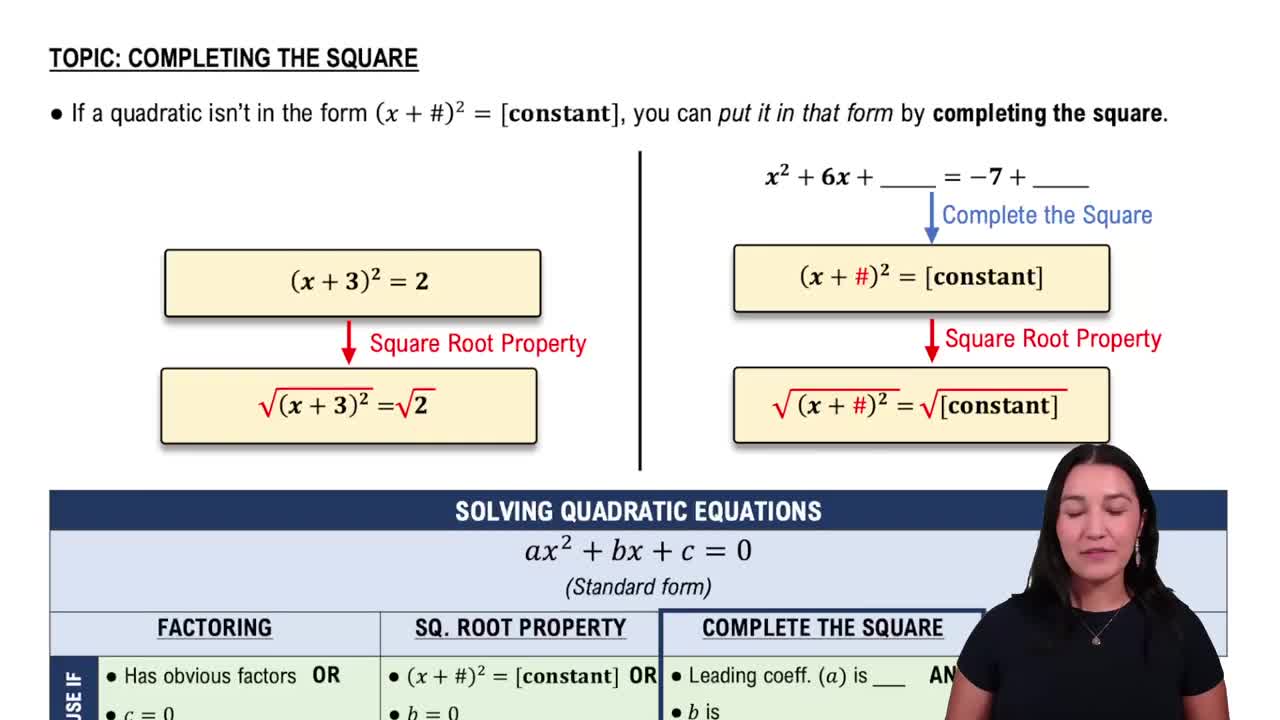
Completing the square is a method used to transform a quadratic expression into a perfect square trinomial. This technique is particularly useful for factoring quadratics that do not factor easily or for deriving the quadratic formula. It involves manipulating the expression to create a binomial squared, which can then be factored or solved more easily.

 3:02 minutes
 Verified step by step guidance
 06:08
06:08