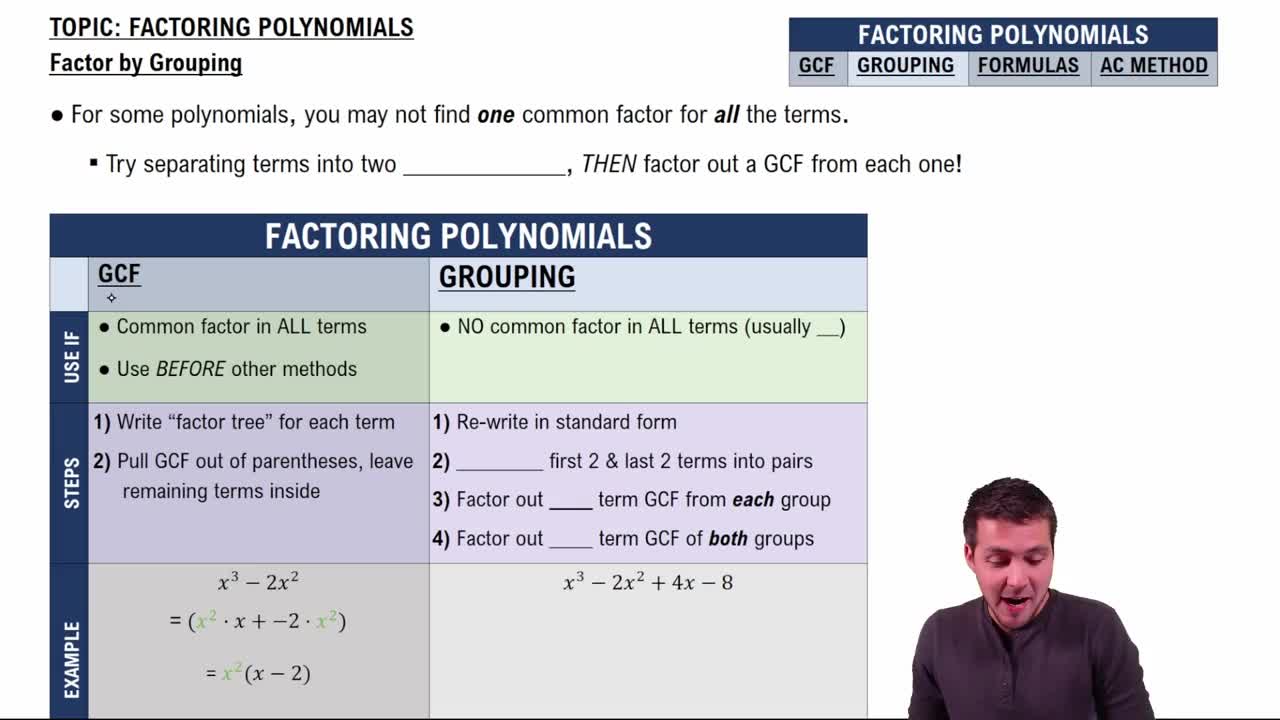
Group the terms into two pairs: (acx^2 - bcx) and (-adx + bd)
Factor out the greatest common factor from each pair: cx(ax - b) and -d(ax - b)
Notice that (ax - b) is a common factor in both terms
Factor out the common factor (ax - b): (ax - b)(cx - d)
Verify the factorization by expanding (ax - b)(cx - d) to ensure it equals the original expression
Verified video answer for a similar problem:
This video solution was recommended by our tutors as helpful for the problem above
Video duration:
2m
Play a video:
0 Comments
Key Concepts
Here are the essential concepts you must grasp in order to answer the question correctly.
Factoring Polynomials
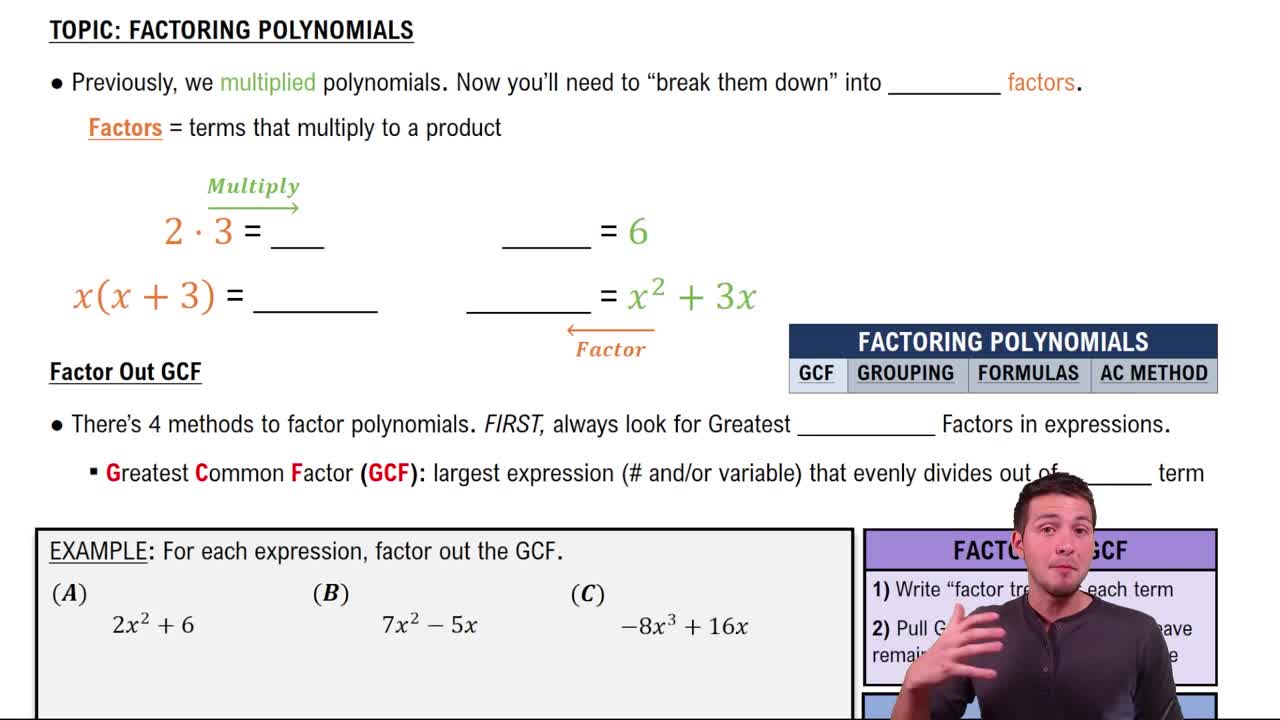
Factoring polynomials involves rewriting a polynomial expression as a product of simpler polynomials. This process is essential for simplifying expressions and solving equations. Common techniques include factoring by grouping, using the distributive property, and applying special product formulas like the difference of squares.
The grouping method is a technique used to factor polynomials with four terms. It involves rearranging the terms into two pairs, factoring out the common factors from each pair, and then factoring out the common binomial factor. This method is particularly useful when the polynomial does not fit standard factoring patterns.
Identifying common factors is crucial in the factoring process. A common factor is a number or variable that divides each term of the polynomial. By factoring out the greatest common factor (GCF) first, the remaining polynomial can often be simplified further, making it easier to factor completely.

 2:03 minutes
 Verified step by step guidance
 07:30
07:30