In Exercises 95–104, factor completely.
x⁶ − 9x³ + 8
Verified step by step guidance
1
Identify the expression: \(x^6 - 9x^3 + 8\). Notice that it is a polynomial in terms of \(x^3\).
Let \(y = x^3\). Substitute \(y\) into the expression to rewrite it as a quadratic: \(y^2 - 9y + 8\).
Factor the quadratic expression \(y^2 - 9y + 8\) by finding two numbers that multiply to 8 and add to -9.
The numbers -1 and -8 satisfy these conditions, so factor the quadratic as \((y - 1)(y - 8)\).
Substitute back \(x^3\) for \(y\) to get \((x^3 - 1)(x^3 - 8)\). Factor each term further if possible.
Verified video answer for a similar problem:
This video solution was recommended by our tutors as helpful for the problem above.
Video duration:
6m
Play a video:
0 Comments
Key Concepts
Here are the essential concepts you must grasp in order to answer the question correctly.
Factoring Polynomials
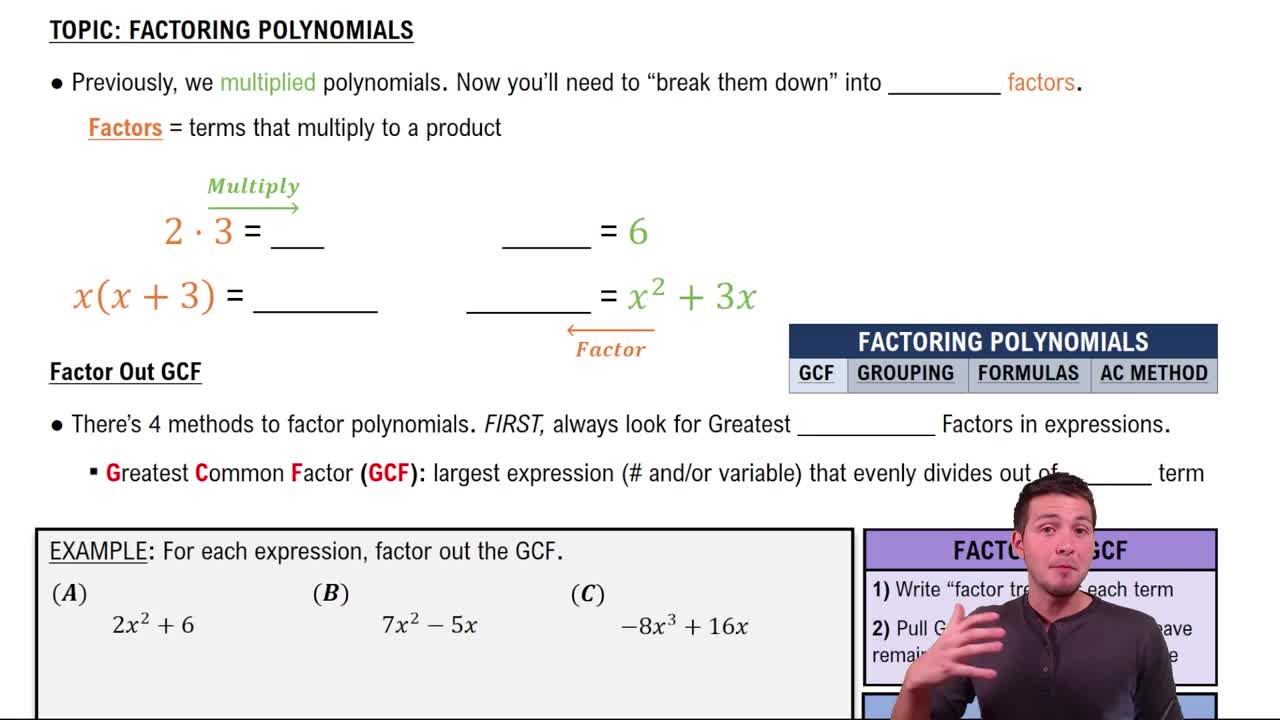
Factoring polynomials involves rewriting a polynomial as a product of simpler polynomials or factors. This process is essential for simplifying expressions, solving equations, and analyzing polynomial behavior. Common techniques include factoring out the greatest common factor, using special product formulas, and applying methods like grouping or synthetic division.
The difference of squares is a specific factoring pattern that applies to expressions of the form a² - b², which can be factored into (a - b)(a + b). In the given polynomial, recognizing components that fit this pattern can simplify the factoring process, especially when dealing with higher-degree polynomials.
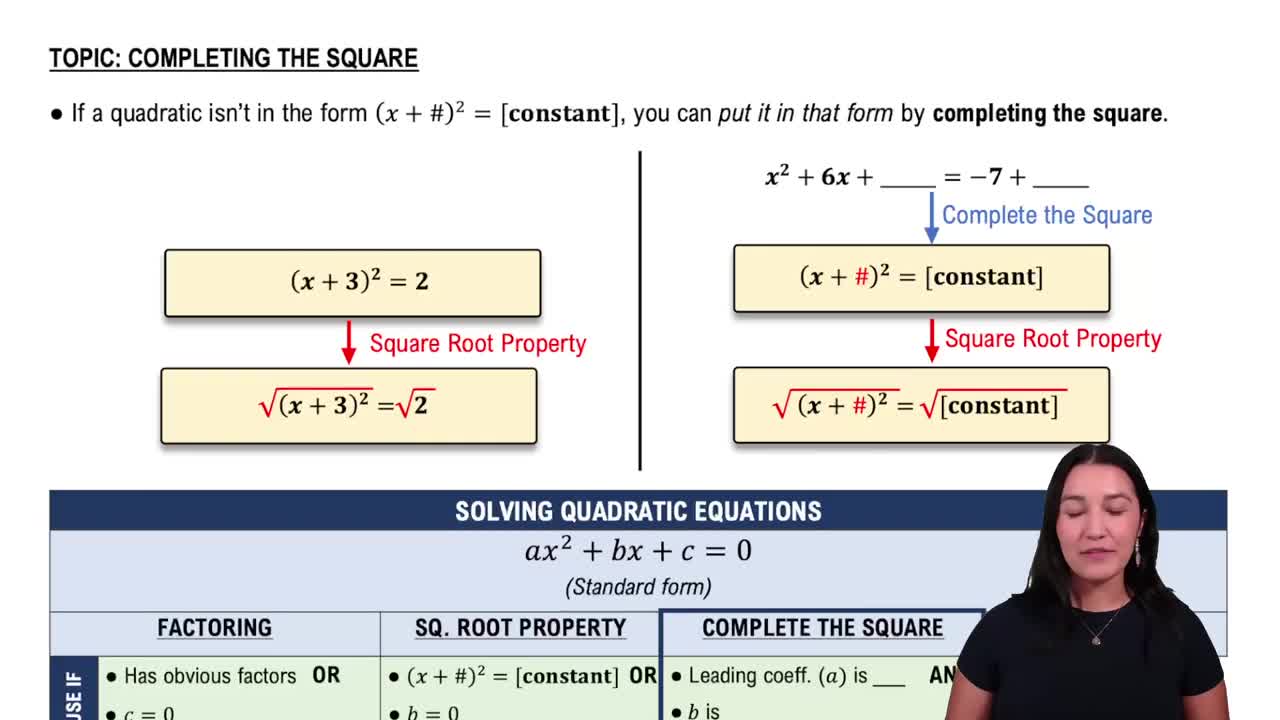
Solving Quadratic Equations by Completing the Square
Substitution Method
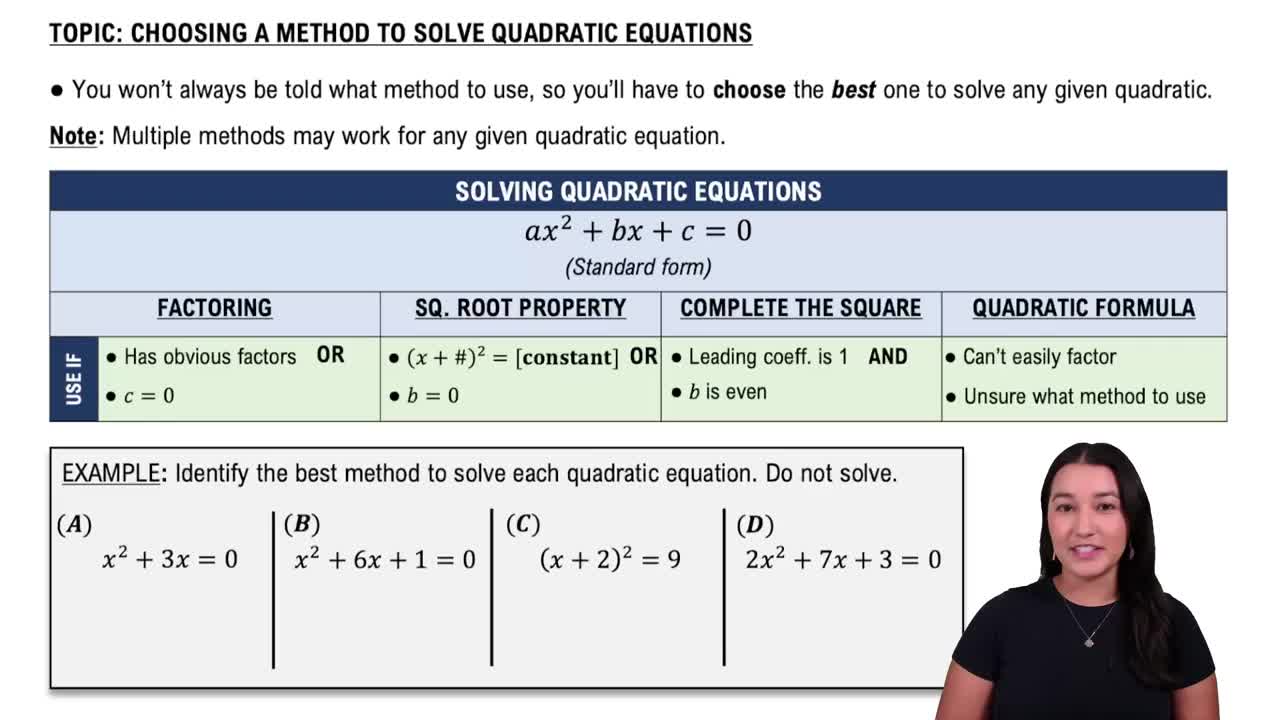
The substitution method is a technique used to simplify complex polynomials by substituting a variable for a polynomial expression. For example, in the expression x⁶ - 9x³ + 8, substituting y = x³ can transform the polynomial into a quadratic form, making it easier to factor and solve. This method is particularly useful for polynomials with terms that can be grouped or simplified.

 6:55 minutes
 Verified step by step guidance
 07:30
07:30