Ch. 50 - Behavioral Ecology
Freeman - Biological Science 8th Edition
Freeman8th EditionBiological ScienceISBN: 9780138276263Not the one you use?Change textbook
Chapter 50, Problem 4

Why does altruism seem paradoxical?
a. Sometimes altruistic behavior is actually selfish.
b. Altruism does not actually help others.
c. Alleles that cause an organism to behave altruistically should be selected against since these alleles should lower the organism's fitness.
d. Animals behave altruistically to help the species, but sometimes their behavior harms the species.

Verified step by step guidance
1
Understand the concept of altruism in biology: Altruism refers to behaviors that benefit other individuals at a cost to oneself. This can seem paradoxical because natural selection typically favors traits that increase an individual's own fitness.
Consider the role of alleles in altruistic behavior: Alleles that promote altruistic behavior might reduce an individual's fitness because they involve sacrificing personal resources or opportunities for the benefit of others.
Analyze the paradox: If altruistic alleles reduce individual fitness, they should be selected against in evolutionary terms. However, altruism is observed in nature, suggesting there might be other factors at play.
Explore potential explanations for altruism: One explanation is kin selection, where altruistic behavior increases the survival and reproductive success of relatives, indirectly benefiting the altruist's genetic lineage.
Evaluate the options given in the problem: Option c highlights the paradox by suggesting that altruistic alleles should be selected against due to reduced fitness, yet altruism persists, indicating a deeper evolutionary mechanism.

Verified video answer for a similar problem:

This video solution was recommended by our tutors as helpful for the problem above.
Video duration:
3m
Was this helpful?

Key Concepts

Here are the essential concepts you must grasp in order to answer the question correctly.

Altruism in Biology

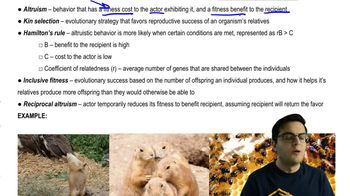
Altruism in biology refers to behaviors by an organism that benefit other organisms at a cost to itself. This seems paradoxical because natural selection typically favors traits that increase an individual's own fitness. Altruistic acts, such as sharing food or warning of predators, can reduce the altruist's chances of survival or reproduction, raising questions about how such traits persist in populations.
Recommended video:
Guided course
07:15
Migration and Altruism

Fitness and Natural Selection

Fitness in evolutionary biology is the ability of an organism to survive and reproduce, passing on its genes to the next generation. Natural selection is the process where traits that enhance fitness become more common in a population over time. Altruistic behaviors, which may lower an individual's fitness, challenge the traditional view of natural selection, as they seem to contradict the idea that only advantageous traits are preserved.
Recommended video:
04:43
Natural Selection

Kin Selection and Inclusive Fitness

Kin selection is a mechanism that explains altruism by suggesting that individuals can increase their genetic success through behaviors that help relatives, who share their genes. Inclusive fitness extends the concept of fitness to include the reproductive success of relatives. This theory suggests that altruistic behaviors can evolve if they increase the overall genetic representation in the population, even if they reduce the individual's direct fitness.
Recommended video:
Guided course
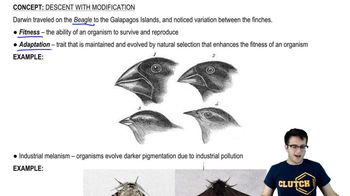
06:20
Fitness, Adaptation, and Artificial Selection