
What do proximate explanations of behavior focus on? a. how displays and other types of behavior have changed through time, or evolved b. the 'adaptive significance' of a behavior c. genetic, neurological, and hormonal mechanisms of behavior d. appropriate experimental methods when studying behavior
Ch. 50 - Behavioral Ecology
Chapter 50, Problem 2
What do ultimate explanations of behavior focus on?
Verified step by step guidance1
Ultimate explanations of behavior focus on understanding why a behavior occurs in the context of natural selection and evolution. They look at the adaptive value a behavior may have and how it contributes to survival and reproductive success.
These explanations often involve examining the evolutionary history of a species to see how certain behaviors may have been favored by natural selection.
Ultimate explanations contrast with proximate explanations, which deal with the immediate physiological or environmental factors that trigger a behavior.
To study ultimate explanations, biologists might use comparative methods, looking at similar behaviors in closely related species to understand their evolutionary origins and functions.
Overall, ultimate explanations help us understand the 'why' behind behaviors in the biological sense, contributing to our knowledge of animal behavior and evolution.

Verified video answer for a similar problem:
This video solution was recommended by our tutors as helpful for the problem above.
Video duration:
2mWas this helpful?
Key Concepts
Here are the essential concepts you must grasp in order to answer the question correctly.
Ultimate Explanations
Ultimate explanations in biology refer to the 'why' of behavior, focusing on the evolutionary significance and adaptive value of certain actions. They seek to understand how behaviors enhance survival and reproduction, thus contributing to the fitness of an organism in its environment.
Recommended video:
Guided course
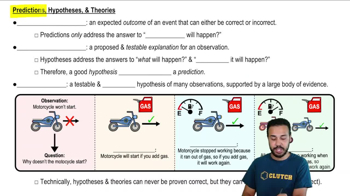
Predictions, Hypotheses, & Theories
Evolutionary Psychology
Evolutionary psychology is a theoretical approach that examines psychological traits—such as memory, perception, and language—as evolved adaptations. It posits that many human behaviors can be understood through the lens of natural selection, providing insights into why certain behaviors may have developed over time.
Recommended video:
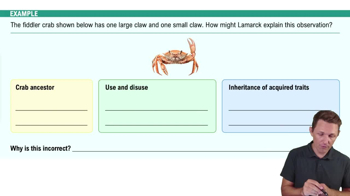
History of Evolutionary Theory Example 1
Natural Selection
Natural selection is a fundamental mechanism of evolution, where individuals with traits better suited to their environment are more likely to survive and reproduce. This process leads to the gradual adaptation of species, influencing behaviors that enhance reproductive success and survival in specific ecological contexts.
Recommended video:
Natural Selection
Related Practice
Textbook Question
1376
views
Textbook Question
A behavior is considered adaptive if it increases an individual's fitness. How is fitness measured? Select True or False for each statement.
T/F Strength
T/F Body size
T/F Speed
T/F Number of viable offspring
1016
views
Textbook Question
Why does altruism seem paradoxical?
a. Sometimes altruistic behavior is actually selfish.
b. Altruism does not actually help others.
c. Alleles that cause an organism to behave altruistically should be selected against since these alleles should lower the organism's fitness.
d. Animals behave altruistically to help the species, but sometimes their behavior harms the species.
1263
views
Textbook Question
Is it true that all organisms forage optimally? Why or why not?
925
views
