

Ch. 42 - Gas Exchange and Circulation
Freeman - Biological Science 8th Edition
Freeman8th EditionBiological ScienceISBN: 9780138276263Not the one you use?Change textbook
Chapter 42, Problem 15e

During exercise, the cardiovascular system must supply muscles with large amounts of oxygen and fuel and get rid of a lot of waste.
How do the cardiovascular systems of athletes respond to prolonged exercise?
Researchers have also observed that athletes and non-athletes have the same mean resting cardiac output, even though athletes have a far lower resting heart rate. How is this possible?

Verified step by step guidance
1
Understand the role of the cardiovascular system during exercise: It is responsible for delivering oxygen and nutrients to muscles and removing waste products like carbon dioxide and lactic acid.
Recognize that during prolonged exercise, an athlete's cardiovascular system adapts by increasing the efficiency of the heart and blood vessels. This includes an increase in stroke volume, which is the amount of blood pumped by the heart with each beat.
Explain that stroke volume increases due to the heart muscle becoming stronger and more efficient, allowing it to pump more blood per beat. This adaptation is a result of regular and intense training.
Discuss how athletes can have a lower resting heart rate yet maintain the same cardiac output as non-athletes. Cardiac output is calculated as the product of heart rate and stroke volume: Cardiac Output=Heart Rate × Stroke Volume. Athletes have a higher stroke volume, which compensates for their lower heart rate.
Conclude that the adaptations in the cardiovascular system of athletes allow them to efficiently meet the increased demands of exercise, while maintaining a lower resting heart rate due to increased stroke volume, resulting in the same cardiac output as non-athletes.

Verified video answer for a similar problem:

This video solution was recommended by our tutors as helpful for the problem above.
Video duration:
1m
Was this helpful?

Key Concepts

Here are the essential concepts you must grasp in order to answer the question correctly.

Cardiac Output

Cardiac output is the volume of blood the heart pumps per minute, calculated as the product of heart rate and stroke volume. Despite athletes having a lower resting heart rate, their cardiac output remains similar to non-athletes due to a higher stroke volume, meaning their hearts pump more blood per beat.
Recommended video:
Guided course
05:37
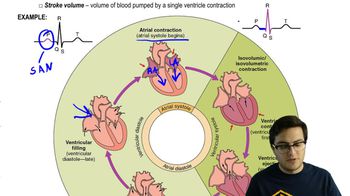
Cardiac Cycle

Stroke Volume

Stroke volume refers to the amount of blood ejected by the left ventricle of the heart in one contraction. Athletes typically have a higher stroke volume due to increased heart muscle efficiency and size, allowing them to maintain adequate cardiac output even with a lower heart rate.
Recommended video:
Guided course
07:47
Surface Area to Volume Ratio

Cardiovascular Adaptations to Exercise

Prolonged exercise leads to cardiovascular adaptations such as increased heart muscle strength, improved blood vessel elasticity, and enhanced oxygen delivery. These adaptations enable athletes to efficiently supply muscles with oxygen and nutrients while removing waste products during exercise.
Recommended video:
05:24
Adaptive Radiation
Related Practice
Textbook Question

During exercise, the cardiovascular system must supply muscles with large amounts of oxygen and fuel and get rid of a lot of waste.

How do the cardiovascular systems of athletes respond to prolonged exercise?

When athletes exercise, what is the primary physiological variable responsible for their sustained increase in ventilation rate?

a. Decreased blood PO₂

b. Increased blood PCO2

c. Increased blood pH

d. Increased body temperature

915
views
Textbook Question

During exercise, the cardiovascular system must supply muscles with large amounts of oxygen and fuel and get rid of a lot of waste.

How do the cardiovascular systems of athletes respond to prolonged exercise?

Researchers used echocardiography, a sonogram of the heart, to estimate the mass of the left ventricle in current athletes, non-athletes, and ex-athletes. The data are graphed below (***meansP<0.001, and the P value comparing non-athletes and ex-athletes is >0.05).

What conclusion can be drawn from the graph?

655
views
Textbook Question

During exercise, the cardiovascular system must supply muscles with large amounts of oxygen and fuel and get rid of a lot of waste.

How do the cardiovascular systems of athletes respond to prolonged exercise?

Explain the advantage of the observed difference between current athletes and non-athletes in the graph shown here.

563
views
Textbook Question

During exercise, the cardiovascular system must supply muscles with large amounts of oxygen and fuel and get rid of a lot of waste.

How do the cardiovascular systems of athletes respond to prolonged exercise?

Athletes are not the only people with enlarged hearts. Many patients with cardiovascular disease also have enlarged hearts. Suggest a cause of this enlargement.

653
views