Ch. 23 - Evolutionary Processes
Freeman - Biological Science 8th Edition
Freeman8th EditionBiological ScienceISBN: 9780138276263Not the one you use?Change textbook
Chapter 23, Problem 2

Why isn't inbreeding considered an evolutionary process?
a. It does not change genotype frequencies.
b. It does not change allele frequencies.
c. It does not occur often enough to be important in evolution.
d. It does not violate the assumptions of the Hardy–Weinberg principle.

Verified step by step guidance
1
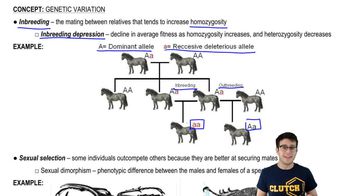
Understand the concept of inbreeding: Inbreeding refers to the mating of individuals who are closely related genetically. This can lead to an increase in homozygosity, where individuals have two identical alleles for a particular gene.
Consider the impact on allele frequencies: Inbreeding does not change allele frequencies in a population. Allele frequencies remain constant because inbreeding only affects how alleles are distributed among individuals, not the overall genetic makeup of the population.
Examine genotype frequencies: Inbreeding can change genotype frequencies by increasing the proportion of homozygous individuals. However, this change in genotype frequencies does not equate to an evolutionary process, as evolution involves changes in allele frequencies over time.
Review the Hardy-Weinberg principle: The Hardy-Weinberg principle states that allele and genotype frequencies in a population will remain constant from generation to generation in the absence of evolutionary influences. Inbreeding does not violate this principle because it does not alter allele frequencies.
Evaluate the significance in evolution: While inbreeding can have significant effects on individual fitness and population health, it is not considered an evolutionary process because it does not lead to changes in allele frequencies, which are necessary for evolution to occur.

Verified video answer for a similar problem:

This video solution was recommended by our tutors as helpful for the problem above.
Video duration:
1m
Was this helpful?

Key Concepts

Here are the essential concepts you must grasp in order to answer the question correctly.

Inbreeding

Inbreeding refers to the mating of closely related individuals, which increases the chance of offspring inheriting identical alleles from both parents. While it affects genotype frequencies by increasing homozygosity, it does not alter allele frequencies in a population, which is why it is not considered an evolutionary process.
Recommended video:
Guided course
07:31
Inbreeding and Sexual Selection

Allele Frequencies

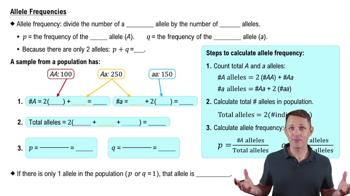
Allele frequencies represent the relative frequency of different alleles of a gene in a population. Evolutionary processes, such as natural selection, mutation, and genetic drift, change these frequencies over time. Inbreeding does not change allele frequencies, thus it does not contribute to evolution in the same way these processes do.
Recommended video:
06:36
Allele Frequencies

Hardy–Weinberg Principle

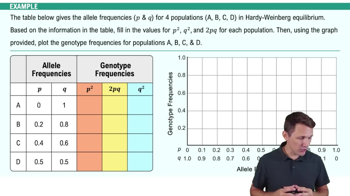
The Hardy–Weinberg principle provides a model for genetic equilibrium in a population, assuming no evolutionary influences like mutation, selection, or migration. Inbreeding does not violate this principle because it does not change allele frequencies, although it does affect genotype frequencies by increasing homozygosity.
Recommended video:
07:10
The Hardy-Weinberg Principle Example 1