Ch. 23 - Evolutionary Processes
Freeman - Biological Science 8th Edition
Freeman8th EditionBiological ScienceISBN: 9780138276263Not the one you use?Change textbook
Chapter 23, Problem 3

Why is genetic drift aptly named? Select True or False for each statement.
T/F It causes allele frequencies to drift up or down randomly.
T/F It occurs when alleles from one population drift into another.
T/F It occurs when mutations drift into a genome.

Verified step by step guidance
1
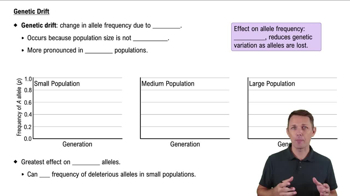
Genetic drift is a mechanism of evolution that refers to random changes in allele frequencies within a population. This randomness is why the term 'drift' is used, as allele frequencies can drift up or down without any specific direction.
Consider the statement: 'It causes allele frequencies to drift up or down randomly.' This statement is true because genetic drift involves random fluctuations in allele frequencies due to chance events, especially in small populations.
Examine the statement: 'It occurs when alleles from one population drift into another.' This statement is false because genetic drift does not involve the movement of alleles between populations; that process is known as gene flow.
Analyze the statement: 'It occurs when mutations drift into a genome.' This statement is false because genetic drift does not involve the introduction of new mutations into a genome; mutations are separate events that can introduce new alleles, but genetic drift affects existing allele frequencies.
To summarize, genetic drift is aptly named because it involves random changes in allele frequencies within a population, not the movement of alleles between populations or the introduction of mutations.

Verified video answer for a similar problem:

This video solution was recommended by our tutors as helpful for the problem above.
Video duration:
1m
Was this helpful?

Key Concepts

Here are the essential concepts you must grasp in order to answer the question correctly.

Genetic Drift

Genetic drift is a mechanism of evolution that refers to random changes in allele frequencies within a population. Unlike natural selection, which involves differential survival and reproduction, genetic drift occurs by chance and can lead to significant genetic variation over time, especially in small populations.
Recommended video:
05:06
Genetic Drift

Allele Frequencies

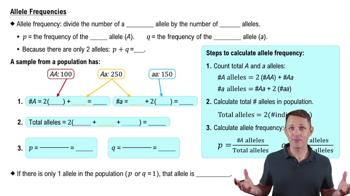
Allele frequencies represent the relative frequency of an allele at a particular genetic locus in a population. They are a fundamental concept in population genetics, as they help in understanding how populations evolve over time. Changes in allele frequencies can occur due to various factors, including genetic drift, mutation, migration, and natural selection.
Recommended video:
06:36
Allele Frequencies

Population Genetics

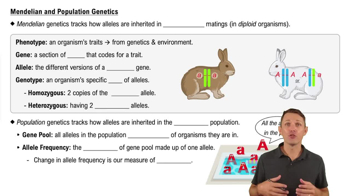
Population genetics is the study of genetic variation within populations and involves the examination of allele frequency distributions and changes under the influence of evolutionary processes. It provides insights into how genetic drift, along with other factors like mutation and selection, affects the genetic structure of populations over time.
Recommended video:
04:26
Mendelian and Population Genetics