Ch. 10 - Photosynthesis
Freeman - Biological Science 8th Edition
Freeman8th EditionBiological ScienceISBN: 9780138276263Not the one you use?Change textbook
Chapter 10, Problem 1

How is energy transferred among antenna pigment molecules?
a. By heat
b. By redox reactions
c. By fluorescence
d. By resonance

Verified step by step guidance
1
Understand the role of antenna pigment molecules: These molecules are part of the photosynthetic apparatus in plants and algae, responsible for capturing light energy.
Recognize the concept of resonance energy transfer: This is a process where energy is transferred from one molecule to another without the movement of electrons, typically occurring in photosynthetic systems.
Identify the mechanism of energy transfer: In photosynthesis, energy captured by antenna pigments is transferred to the reaction center through resonance energy transfer, allowing the energy to be used in chemical reactions.
Differentiate resonance from other forms of energy transfer: Unlike heat transfer, which involves thermal energy, or redox reactions, which involve electron transfer, resonance energy transfer involves the transfer of energy through electromagnetic interactions.
Conclude that resonance energy transfer is the correct mechanism: This process allows efficient energy transfer among antenna pigment molecules, facilitating the conversion of light energy into chemical energy.

Verified video answer for a similar problem:

This video solution was recommended by our tutors as helpful for the problem above.
Video duration:
3m
Was this helpful?

Key Concepts

Here are the essential concepts you must grasp in order to answer the question correctly.

Antenna Pigment Molecules

Antenna pigment molecules are part of the photosynthetic apparatus in plants and algae, responsible for capturing light energy. These pigments, such as chlorophylls and carotenoids, absorb photons and transfer the energy to the reaction center, initiating the process of photosynthesis. Their arrangement allows efficient energy transfer through resonance energy transfer.
Recommended video:
Guided course
05:58
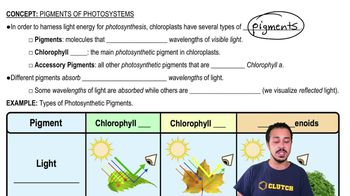
Pigments of Photosynthesis

Resonance Energy Transfer

Resonance energy transfer, also known as Förster resonance energy transfer (FRET), is a mechanism by which energy is transferred non-radiatively between molecules. In photosynthesis, this process occurs when an excited electron in one pigment molecule transfers its energy to a neighboring molecule without the emission of a photon, facilitating efficient energy movement within the antenna complex.
Recommended video:
Guided course
04:58
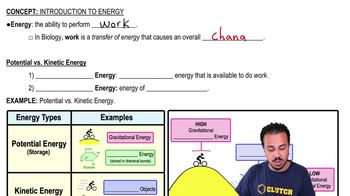
Introduction to Energy

Photosynthesis

Photosynthesis is the process by which green plants, algae, and some bacteria convert light energy into chemical energy stored in glucose. It involves capturing light energy through antenna pigments, transferring it to the reaction center, and using it to drive the synthesis of ATP and NADPH, which are then used to fix carbon dioxide into organic compounds.
Recommended video:
Guided course
05:58
Pigments of Photosynthesis