Ch. 17 - Gene Expression: From Gene to Protein
Campbell - Campbell Biology 11th Edition
Urry11th EditionCampbell BiologyISBN: 9789357423311Not the one you use?Change textbook
Chapter 17, Problem 7

Which of the following mutations would be most likely to have a harmful effect on an organism?
a. A deletion of three nucleotides near the middle of a gene
b. A single nucleotide deletion in the middle of an intron
c. A single nucleotide deletion near the end of the coding sequence
d. A single nucleotide insertion downstream of, and close to, the start of the coding sequence

Verified step by step guidance
1
Understand the types of mutations: Mutations can be insertions, deletions, or substitutions of nucleotides in the DNA sequence. Each type can have different effects depending on its location within the gene.
Consider the impact of a deletion of three nucleotides: Deleting three nucleotides may remove an entire codon, potentially affecting one amino acid in the protein sequence, but it does not cause a frameshift mutation.
Evaluate the effect of a single nucleotide deletion in an intron: Introns are non-coding regions, so a deletion here is less likely to affect the protein unless it disrupts splicing sites.
Analyze the consequence of a single nucleotide deletion near the end of the coding sequence: This could lead to a frameshift mutation, altering the reading frame and potentially affecting the protein's function.
Assess the impact of a single nucleotide insertion near the start of the coding sequence: An insertion here can cause a frameshift mutation, which is likely to have a significant effect on the protein's structure and function.

Verified video answer for a similar problem:

This video solution was recommended by our tutors as helpful for the problem above.
Video duration:
1m
Was this helpful?

Key Concepts

Here are the essential concepts you must grasp in order to answer the question correctly.

Gene Mutations

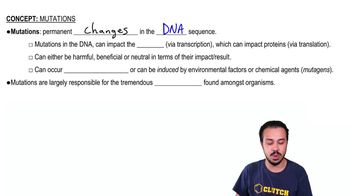
Gene mutations are changes in the nucleotide sequence of DNA, which can affect the structure and function of proteins. Mutations can be classified as point mutations, insertions, deletions, or duplications, each having different impacts on the organism depending on their location and nature. Understanding how mutations alter genetic information is crucial for assessing their potential harm.
Recommended video:

Frameshift Mutations

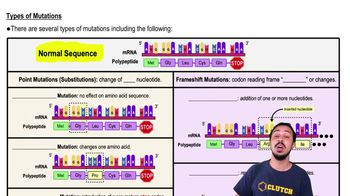
Frameshift mutations occur when nucleotides are inserted or deleted from the DNA sequence, altering the reading frame of the gene. This can lead to significant changes in the amino acid sequence of the resulting protein, often resulting in nonfunctional proteins. Frameshift mutations are typically more harmful than point mutations because they affect all downstream codons.
Recommended video:
Guided course
08:44
Types of Mutations

Coding Sequence

The coding sequence of a gene is the portion of DNA that is transcribed into mRNA and translated into a protein. Mutations within the coding sequence can directly affect protein synthesis, potentially leading to dysfunctional proteins. The location of a mutation within the coding sequence, such as near the start or end, can influence its impact on protein function and organismal health.
Recommended video: