
Textbook Question
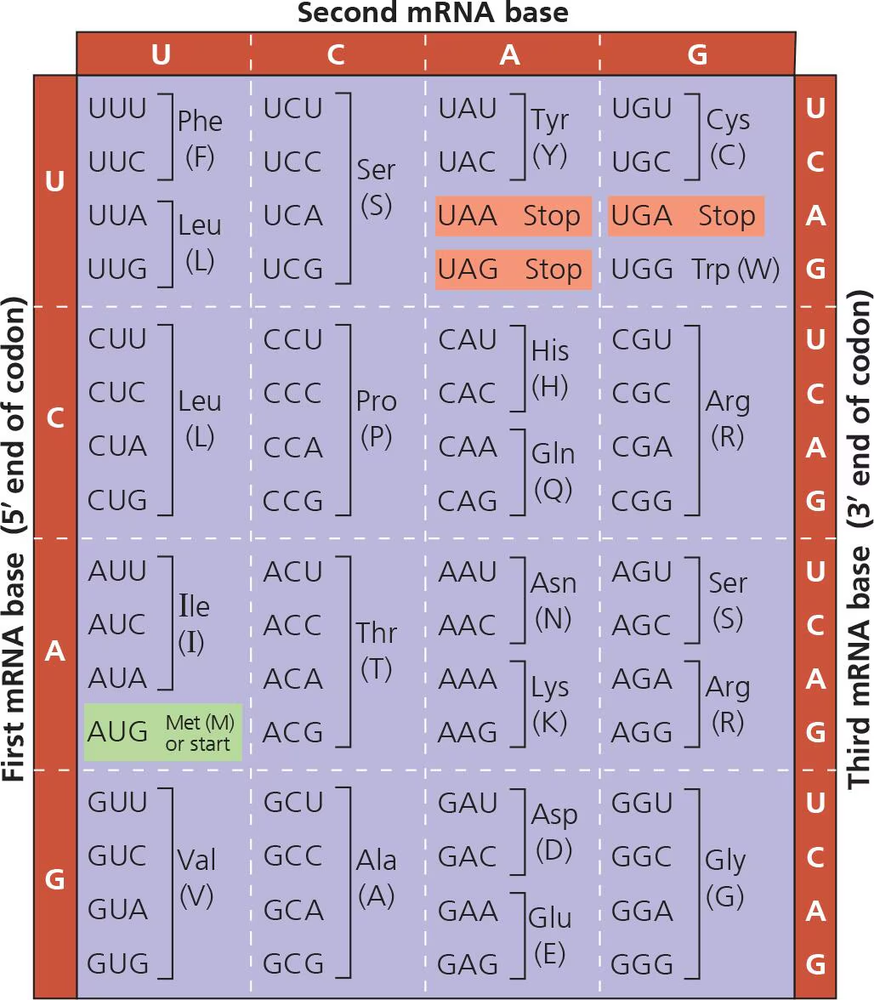
Complete the following table:
588
views

 Verified step by step guidance
 05:15
05:15
 07:20
07:20 04:07
04:07Complete the following table:
Which of the following mutations would be most likely to have a harmful effect on an organism?
a. A deletion of three nucleotides near the middle of a gene
b. A single nucleotide deletion in the middle of an intron
c. A single nucleotide deletion near the end of the coding sequence
d. A single nucleotide insertion downstream of, and close to, the start of the coding sequence
Which component is not directly involved in translation?
a. GTP
b. DNA
c. tRNA
d. ribosomes
Which of the following is not true of RNA processing?
a. Exons are cut out before mRNA leaves the nucleus.
b. Nucleotides may be added at both ends of the RNA.
c. Ribozymes may function in RNA splicing.
d. RNA splicing can be catalyzed by spliceosomes.
Would the coupling of the processes shown in Figure 17.24 be found in a eukaryotic cell? Explain why or why not.
<IMAGE>
The anticodon of a particular tRNA molecule is
a. Complementary to the corresponding mRNA codon
b. Complementary to the corresponding triplet in rRNA
c. The part of tRNA that bonds to a specific amino acid
d. Catalytic, making the tRNA a ribozyme