Ch. 32 - An Overview of Animal Diversity
Campbell - Campbell Biology 12th Edition
Urry12th EditionCampbell BiologyISBN: 9785794169850Not the one you use?Change textbook
Chapter 32, Problem 3

Which of the following was probably an important factor in bringing about the Cambrian explosion?
a. The movement of animals onto land
b. An increase in the concentration of atmospheric nitrogen
c. The emergence of predator-prey relationships
d. The origin of bilaterian animals

Verified step by step guidance
1
Understand the Cambrian explosion: It was a period approximately 541 million years ago when there was a rapid diversification of multicellular organisms, leading to the appearance of most major animal phyla.
Consider the options: (A) movement of animals onto land, (B) increase in atmospheric nitrogen, (C) emergence of predator-prey relationships, (D) origin of bilaterian animals.
Evaluate option (A): The movement of animals onto land occurred much later than the Cambrian explosion, so it is unlikely to be a contributing factor.
Evaluate option (B): While atmospheric changes can influence evolution, nitrogen is not directly linked to the diversification seen in the Cambrian explosion.
Evaluate options (C) and (D): The emergence of predator-prey relationships (C) could drive evolutionary changes due to natural selection pressures, and the origin of bilaterian animals (D) represents a significant evolutionary development that could lead to diversification.

Verified video answer for a similar problem:

This video solution was recommended by our tutors as helpful for the problem above.
Video duration:
2m
Was this helpful?

Key Concepts

Here are the essential concepts you must grasp in order to answer the question correctly.

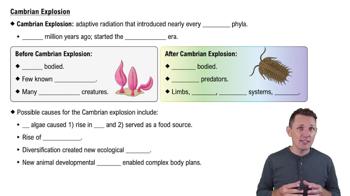
Cambrian Explosion

The Cambrian Explosion refers to a period approximately 541 million years ago when there was a rapid diversification of life forms on Earth. This event is marked by the sudden appearance of most major animal phyla in the fossil record. It is significant because it represents a major evolutionary milestone, leading to the complex ecosystems we see today.
Recommended video:
05:10
Cambrian Explosion

Predator-Prey Relationships

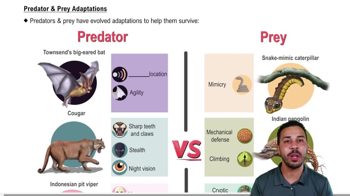
Predator-prey relationships involve interactions where one organism (the predator) hunts and consumes another organism (the prey). These interactions can drive evolutionary changes, as prey species develop adaptations to avoid predation, and predators evolve strategies to catch prey. Such dynamics can lead to increased biodiversity and complexity in ecosystems, potentially contributing to events like the Cambrian Explosion.
Recommended video:
Guided course
03:01
Predator & Prey Adaptations

Bilaterian Animals

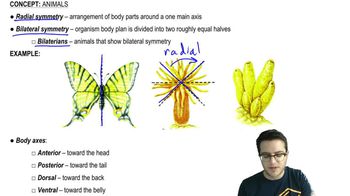
Bilaterian animals are organisms with bilateral symmetry, meaning they have a distinct front and back, as well as a top and bottom. This body plan allows for more complex structures and functions, such as a centralized nervous system. The emergence of bilaterians is considered a key evolutionary development, as it enabled greater mobility and diversity, which may have played a role in the Cambrian Explosion.
Recommended video:
Guided course
04:31
Overview of Animals - 4