In Exercises 59–74, convert each polar equation to a rectangular equation. Then use a rectangular coordinate system to graph the rectangular equation. r = 8
Ch. 5 - Complex Numbers, Polar Coordinates and Parametric Equations

All textbooks
Blitzer 3rd Edition
Ch. 5 - Complex Numbers, Polar Coordinates and Parametric Equations
Problem 5.5.55
Blitzer 3rd Edition
Ch. 5 - Complex Numbers, Polar Coordinates and Parametric Equations
Problem 5.5.55Chapter 5, Problem 5.5.55
In Exercises 53–56, find two different sets of parametric equations for each rectangular equation. y = x² + 4
Verified step by step guidance1
Recognize that the given rectangular equation is a parabola: \(y = x^{2} + 4\). Our goal is to express both \(x\) and \(y\) in terms of a parameter \(t\) to form parametric equations.
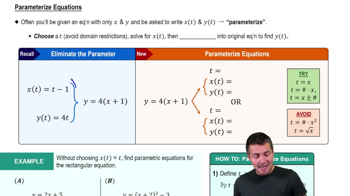
For the first set of parametric equations, let the parameter \(t\) represent \(x\). So, set \(x = t\). Then, substitute \(t\) into the original equation to find \(y\): \(y = t^{2} + 4\). Thus, the first set is \(x = t\), \(y = t^{2} + 4\).
For the second set, choose a different parameterization. For example, let \(t\) represent \(y\). From the original equation, solve for \(x\) in terms of \(y\): \(x = \pm \sqrt{y - 4}\). To avoid ambiguity, pick one branch, say the positive root, and set \(y = t\). Then, \(x = \sqrt{t - 4}\). So the second set is \(x = \sqrt{t - 4}\), \(y = t\), with the domain \(t \geq 4\).
Alternatively, for the second set, you can introduce a trigonometric parameterization by letting \(x = 2 \tan t\). Substitute into the original equation: \(y = (2 \tan t)^{2} + 4 = 4 \tan^{2} t + 4\). So the parametric equations become \(x = 2 \tan t\), \(y = 4 \tan^{2} t + 4\), where \(t\) is in the domain where \(\tan t\) is defined.
Summarize that parametric equations are flexible and can be chosen by assigning the parameter to either \(x\), \(y\), or a function of \(t\), then expressing the other variable accordingly to satisfy the original rectangular equation.

Verified video answer for a similar problem:
This video solution was recommended by our tutors as helpful for the problem above.
Video duration:
1mWas this helpful?
Key Concepts
Here are the essential concepts you must grasp in order to answer the question correctly.
Rectangular and Parametric Equations
A rectangular equation relates x and y directly, while parametric equations express both x and y as functions of a third variable, usually t. Converting between these forms allows for different representations of the same curve, useful in analyzing motion or graphing.
Recommended video:
Parameterizing Equations
Parametrization Techniques
Parametrization involves choosing a parameter t and expressing x and y in terms of t to satisfy the original equation. Common methods include letting x = t and solving for y, or using trigonometric or polynomial functions to create alternative parameter sets.
Recommended video:
Parameterizing Equations
Quadratic Functions and Their Graphs
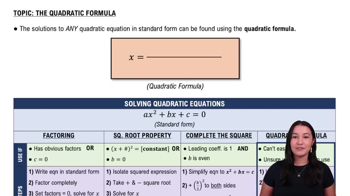
The given equation y = x² + 4 is a parabola shifted upward by 4 units. Understanding the shape and properties of quadratic functions helps in selecting appropriate parametric forms that trace the curve accurately.
Recommended video:
Quadratic Formula
Related Practice
Textbook Question
866
views
Textbook Question
In Exercises 53–64, use DeMoivre's Theorem to find the indicated power of the complex number. Write answers in rectangular form. (1 + i)⁵
571
views
Textbook Question
In Exercises 29–36, simplify and write the result in standard form.
√3² − 4 ⋅ 2 ⋅ 5
469
views
Textbook Question
In Exercises 21–28, divide and express the result in standard form.
2+3i / 2+i
572
views
Textbook Question
In Exercises 45–52, use your answers from Exercises 41–44 and the parametric equations given in Exercises 41–44 to find a set of parametric equations for the conic section or the line.
Ellipse: Center: (−2,3); Vertices: 5 units to the left and right of the center; Endpoints of Minor Axis: 2 units above and below the center
480
views
Textbook Question
In Exercises 1–10, perform the indicated operations and write the result in standard form. (3 − 4i)²
769
views