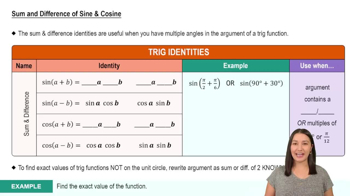
Recall the definition of the sine function on the unit circle: \(\sin(\theta)\) represents the y-coordinate of the point on the unit circle at an angle \(\theta\) measured from the positive x-axis.
Recognize that the angle given is \(-\frac{5\pi}{6}\), which is a negative angle. Negative angles are measured clockwise from the positive x-axis.
Convert the negative angle to a positive coterminal angle by adding \(2\pi\): \(-\frac{5\pi}{6} + 2\pi = \frac{7\pi}{6}\).
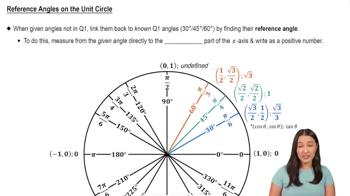
Identify the reference angle for \(\frac{7\pi}{6}\), which is \(\frac{7\pi}{6} - \pi = \frac{\pi}{6}\), and determine the sign of sine in the third quadrant (where \(\frac{7\pi}{6}\) lies).
Use the known sine value for the reference angle \(\frac{\pi}{6}\), which is \(\frac{1}{2}\), and apply the sign from the third quadrant (sine is negative there) to find \(\sin\left(-\frac{5\pi}{6}\right) = -\frac{1}{2}\).
Verified video answer for a similar problem:
This video solution was recommended by our tutors as helpful for the problem above
Play a video:
0 Comments
Key Concepts
Here are the essential concepts you must grasp in order to answer the question correctly.
Unit Circle and Angle Measurement
The unit circle is a circle with radius 1 centered at the origin of the coordinate plane. Angles are measured in radians, where 2π radians equal 360 degrees. Understanding how to locate angles like -5π/6 on the unit circle is essential for finding exact trigonometric values.
A reference angle is the acute angle formed between the terminal side of the given angle and the x-axis. It helps simplify the evaluation of trigonometric functions by relating them to known values in the first quadrant, regardless of the original angle's quadrant or sign.
The sine function corresponds to the y-coordinate on the unit circle. Its value depends on the quadrant of the angle: positive in the first and second quadrants, negative in the third and fourth. Knowing the sign of sine for the angle -5π/6 is crucial for determining the exact value.

 Verified step by step guidance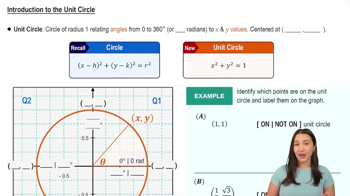
 06:11
06:11