Use a calculator to determine whether each statement is true or false. A true statement may lead to results that differ in the last decimal place due to rounding error. cos 70° = 2 cos² 35° - 1
Verified step by step guidance
1
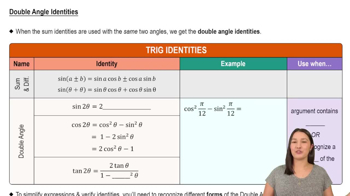
Identify the trigonometric identity: The given statement cos 70° = 2 cos² 35° - 1 is based on the double angle identity for cosine, which states that \( \cos(2\theta) = 2\cos^2(\theta) - 1 \).
Recognize the angle relationship: Notice that 70° is twice 35°, which means \( \theta = 35° \) and \( 2\theta = 70° \).
Apply the identity: Substitute \( \theta = 35° \) into the double angle identity to verify if \( \cos(70°) = 2\cos^2(35°) - 1 \) holds true.
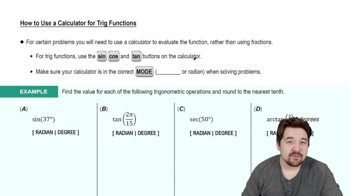
Calculate \( \cos(35°) \) using a calculator to find its value.
Calculate \( 2\cos^2(35°) - 1 \) using the value obtained for \( \cos(35°) \) and compare it with \( \cos(70°) \) to determine if the statement is true or false.
Verified video answer for a similar problem:
This video solution was recommended by our tutors as helpful for the problem above
Video duration:
2m
Play a video:
0 Comments
Key Concepts
Here are the essential concepts you must grasp in order to answer the question correctly.
Cosine Function
The cosine function is a fundamental trigonometric function that relates the angle of a right triangle to the ratio of the length of the adjacent side to the hypotenuse. It is defined for all angles and is periodic, with a range of values between -1 and 1. Understanding the properties of the cosine function is essential for evaluating expressions involving cosine, such as cos 70°.
The double angle formula for cosine states that cos(2θ) = 2cos²(θ) - 1. This formula allows us to express the cosine of a double angle in terms of the cosine of the original angle. In the given statement, recognizing that cos 70° can be rewritten using this formula with θ = 35° is crucial for determining the truth of the statement.
Rounding errors occur when numerical values are approximated to a certain number of decimal places, which can lead to discrepancies in calculations. In trigonometry, using a calculator to evaluate trigonometric functions can introduce small errors due to rounding, especially when comparing values. Understanding how rounding affects results is important when assessing the accuracy of trigonometric identities.

 2:01 minutes
 Verified step by step guidance
 5:53
5:53