Use a calculator to determine whether each statement is true or false. A true statement may lead to results that differ in the last decimal place due to rounding error. 2 cos 38°22' = cos 76°44'
Verified step by step guidance
1
Convert the angle 38°22' to decimal degrees by dividing the minutes by 60 and adding to the degrees: 38 + 22/60.
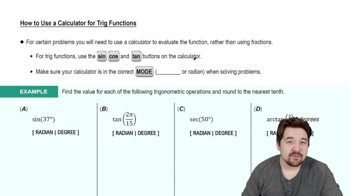
Calculate \( \cos(38.3667°) \) using a calculator.
Double the result from the previous step to find \( 2 \cos(38.3667°) \).
Convert the angle 76°44' to decimal degrees by dividing the minutes by 60 and adding to the degrees: 76 + 44/60.
Calculate \( \cos(76.7333°) \) using a calculator and compare it to the result from step 3 to determine if the statement is true or false.
Verified video answer for a similar problem:
This video solution was recommended by our tutors as helpful for the problem above
Video duration:
2m
Play a video:
0 Comments
Key Concepts
Here are the essential concepts you must grasp in order to answer the question correctly.
Trigonometric Identities
Trigonometric identities are equations that involve trigonometric functions and are true for all values of the variables involved. One important identity is the double angle identity, which states that cos(2θ) = 2cos²(θ) - 1. Understanding these identities is crucial for simplifying expressions and verifying trigonometric equations.
Angle conversion involves changing angles from one unit to another, such as degrees to radians or vice versa. In this question, the angle 38°22' must be understood in terms of its decimal degree equivalent to facilitate calculations. Accurate conversion is essential for applying trigonometric functions correctly.
Rounding errors occur when numerical values are approximated to a certain number of decimal places, which can lead to discrepancies in calculations. In trigonometry, small rounding errors can affect the accuracy of results, especially when comparing values or performing operations. Awareness of these errors is important for interpreting results correctly.