In Exercises 83–94, use a right triangle to write each expression as an algebraic expression. Assume that x is positive and that the given inverse trigonometric function is defined for the expression in x. sec (cos⁻¹ 1/x)
Table of contents
- 0. Review of College Algebra4h 45m
- 1. Measuring Angles40m
- 2. Trigonometric Functions on Right Triangles2h 5m
- 3. Unit Circle1h 19m
- 4. Graphing Trigonometric Functions1h 19m
- 5. Inverse Trigonometric Functions and Basic Trigonometric Equations1h 41m
- 6. Trigonometric Identities and More Equations2h 34m
- 7. Non-Right Triangles1h 38m
- 8. Vectors2h 25m
- 9. Polar Equations2h 5m
- 10. Parametric Equations1h 6m
- 11. Graphing Complex Numbers1h 7m
5. Inverse Trigonometric Functions and Basic Trigonometric Equations
Evaluate Composite Trig Functions
Problem 77
Textbook Question
Evaluate each expression without using a calculator.
cos (tan⁻¹ (-2))
Verified step by step guidance1
Recognize that the expression is \( \cos(\tan^{-1}(-2)) \). Here, \( \tan^{-1}(-2) \) represents an angle \( \theta \) whose tangent is \( -2 \). So, set \( \theta = \tan^{-1}(-2) \), which means \( \tan(\theta) = -2 \).
Visualize or draw a right triangle to represent the angle \( \theta \). Since \( \tan(\theta) = \frac{\text{opposite}}{\text{adjacent}} = -2 \), assign the opposite side length as \( -2 \) and the adjacent side length as \( 1 \) (the negative sign indicates direction, but for length use positive values and consider the quadrant later).
Calculate the hypotenuse \( h \) of the triangle using the Pythagorean theorem: \( h = \sqrt{(\text{opposite})^2 + (\text{adjacent})^2} = \sqrt{(-2)^2 + 1^2} = \sqrt{4 + 1} = \sqrt{5} \).
Recall that \( \cos(\theta) = \frac{\text{adjacent}}{\text{hypotenuse}} \). Using the triangle, this becomes \( \cos(\theta) = \frac{1}{\sqrt{5}} \).
Determine the sign of \( \cos(\theta) \) based on the quadrant of \( \theta \). Since \( \tan(\theta) = -2 \) is negative, \( \theta \) lies either in the second or fourth quadrant. Cosine is positive in the fourth quadrant and negative in the second. Because the tangent is negative and the angle is the inverse tangent of a negative number, \( \theta \) is in the fourth quadrant, so \( \cos(\theta) \) is positive. Therefore, \( \cos(\tan^{-1}(-2)) = \frac{1}{\sqrt{5}} \).
Verified video answer for a similar problem:This video solution was recommended by our tutors as helpful for the problem above
Play a video:
0 Comments
Key Concepts
Here are the essential concepts you must grasp in order to answer the question correctly.
Inverse Tangent Function (tan⁻¹ or arctan)
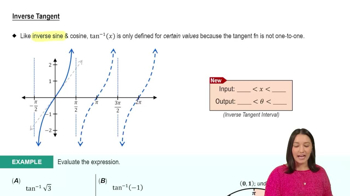
The inverse tangent function, tan⁻¹(x), returns the angle whose tangent is x. It maps a real number to an angle typically in the range (-π/2, π/2). Understanding this helps convert the given value into an angle for further trigonometric evaluation.
Recommended video:
Inverse Tangent
Right Triangle Interpretation of Trigonometric Ratios
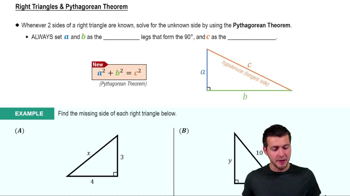
Trigonometric functions can be interpreted using right triangles, where tangent is the ratio of the opposite side to the adjacent side. By representing tan⁻¹(-2) as an angle in a triangle, we can find the lengths of sides and use them to calculate cosine without a calculator.
Recommended video:
Solving Right Triangles with the Pythagorean Theorem
Relationship Between Sine, Cosine, and Tangent
Cosine, sine, and tangent are related by the identity tan(θ) = sin(θ)/cos(θ). Knowing tan(θ), we can express cosine in terms of tangent using the Pythagorean identity cos(θ) = ±1/√(1 + tan²(θ)). This relationship allows evaluation of cosine from a given tangent value.
Recommended video:
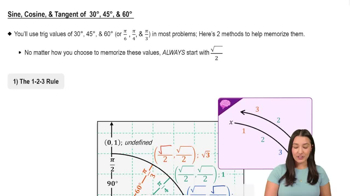
Sine, Cosine, & Tangent of 30°, 45°, & 60°
Related Videos
Related Practice
Textbook Question
637
views