Ch. 2 - Graphs of the Trigonometric Functions; Inverse Trigonometric Functions
Blitzer - Trigonometry 3rd Edition
Blitzer3rd EditionTrigonometryISBN: 9780137316601Not the one you use?Change textbook
Chapter 2, Problem 41

In Exercises 29–51, find the exact value of each expression. Do not use a calculator. tan[sin⁻¹ (− 1/2)]

Verified step by step guidance
1
Recognize that the expression is \( \tan(\sin^{-1}(-\frac{1}{2})) \). This means we need to find the tangent of an angle whose sine is \( -\frac{1}{2} \).
Let \( \theta = \sin^{-1}(-\frac{1}{2}) \). By definition, \( \sin(\theta) = -\frac{1}{2} \), and \( \theta \) lies in the range \( [-\frac{\pi}{2}, \frac{\pi}{2}] \) because that is the principal range of \( \sin^{-1} \).
Use the Pythagorean identity to find \( \cos(\theta) \): \( \cos(\theta) = \pm \sqrt{1 - \sin^2(\theta)} = \pm \sqrt{1 - \left(-\frac{1}{2}\right)^2} = \pm \sqrt{1 - \frac{1}{4}} = \pm \sqrt{\frac{3}{4}} = \pm \frac{\sqrt{3}}{2} \).
Determine the correct sign of \( \cos(\theta) \) based on the quadrant of \( \theta \). Since \( \theta \) is in \( [-\frac{\pi}{2}, \frac{\pi}{2}] \) and \( \sin(\theta) \) is negative, \( \theta \) must be in the fourth quadrant where cosine is positive. So, \( \cos(\theta) = \frac{\sqrt{3}}{2} \).
Finally, calculate \( \tan(\theta) = \frac{\sin(\theta)}{\cos(\theta)} = \frac{-\frac{1}{2}}{\frac{\sqrt{3}}{2}} = -\frac{1}{\sqrt{3}} \).

Verified video answer for a similar problem:

This video solution was recommended by our tutors as helpful for the problem above.
Video duration:
2m
Was this helpful?

Key Concepts

Here are the essential concepts you must grasp in order to answer the question correctly.

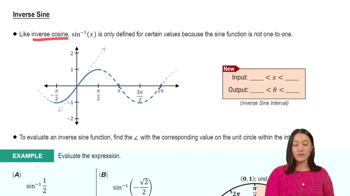
Inverse Sine Function (sin⁻¹ or arcsin)

The inverse sine function, sin⁻¹(x), returns the angle whose sine is x, typically within the range [-π/2, π/2]. Understanding this helps identify the angle corresponding to a given sine value, such as sin⁻¹(-1/2) which yields an angle in the fourth or third quadrant depending on the range.
Recommended video:
4:03
Inverse Sine

Relationship Between Sine and Tangent

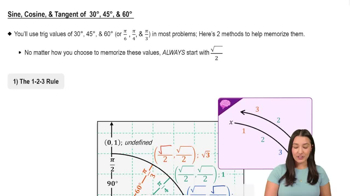
Tangent of an angle is defined as the ratio of sine to cosine (tan θ = sin θ / cos θ). To find tan(sin⁻¹(x)), one must determine the cosine of the angle whose sine is x, often using the Pythagorean identity cos²θ = 1 - sin²θ.
Recommended video:
5:08
Sine, Cosine, & Tangent of 30°, 45°, & 60°

Pythagorean Identity and Sign Determination

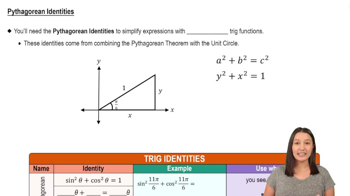
The Pythagorean identity states sin²θ + cos²θ = 1, allowing calculation of cosine from sine values. Additionally, knowing the quadrant of the angle from sin⁻¹ helps determine the correct sign of cosine and tangent, ensuring the exact value is accurate without a calculator.
Recommended video:
6:25
Pythagorean Identities