Determine whether each relation defines y as a function of x. Give the domain and range. See Example 5. x = y⁶
Verified step by step guidance
1
Understand the given relation: \(x = y^{6}\). This means \(x\) is expressed in terms of \(y\), but we need to determine if \(y\) can be expressed as a function of \(x\) (i.e., for each \(x\), is there exactly one \(y\)?).
To check if \(y\) is a function of \(x\), try to solve the equation for \(y\) in terms of \(x\). From \(x = y^{6}\), take the sixth root of both sides: \(y = \pm x^{\frac{1}{6}}\).
Notice that for each positive \(x\), there are two possible values of \(y\) (one positive and one negative), and for \(x=0\), \(y=0\). For negative \(x\), there is no real \(y\) because even powers of real numbers are non-negative.
Since for some \(x\) values there are two \(y\) values, \(y\) is not a function of \(x\) (a function must assign exactly one output for each input).
Determine the domain and range: The domain (possible \(x\) values) is \(x \geq 0\) because \(y^{6}\) cannot be negative for real \(y\). The range (possible \(y\) values) is all real numbers \(y\) because \(y\) can be any real number, and \(y^{6}\) will be non-negative.
Verified video answer for a similar problem:
This video solution was recommended by our tutors as helpful for the problem above
Video duration:
3m
Play a video:
0 Comments
Key Concepts
Here are the essential concepts you must grasp in order to answer the question correctly.
Definition of a Function
A function relates each input value (x) to exactly one output value (y). To determine if y is a function of x, each x must correspond to only one y. If multiple y-values exist for a single x, the relation is not a function.
When solving equations like x = y⁶, taking the sixth root can yield multiple values for y (both positive and negative). This affects whether y is uniquely determined by x, which is crucial for identifying if y is a function of x.
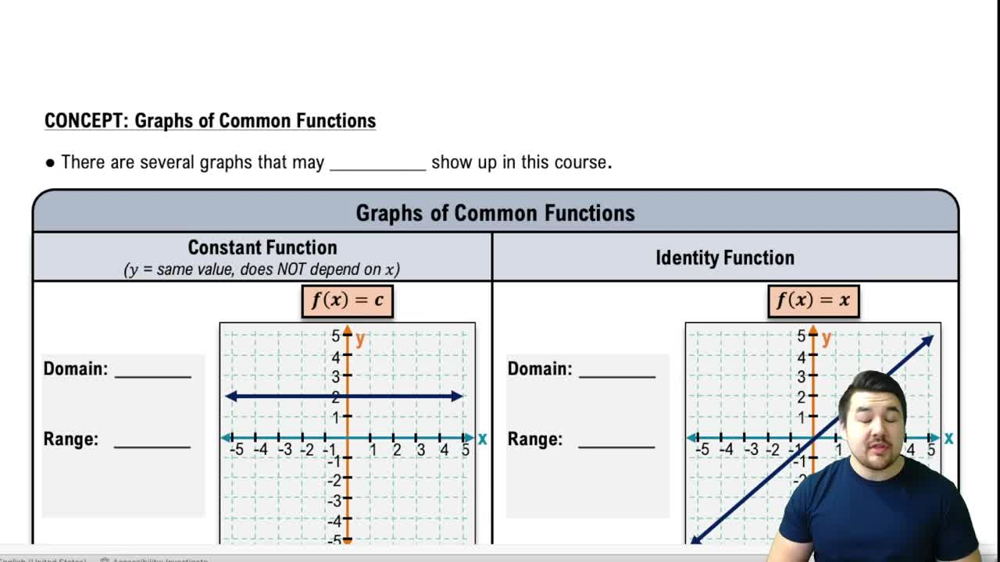
The domain is the set of all possible x-values for which the relation is defined, and the range is the set of all possible y-values. Understanding how to find these sets helps describe the behavior and limitations of the relation.

 3:19 minutes
 Verified step by step guidance
 5:57
5:57