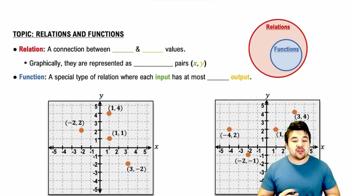
Determine whether each relation defines a function, and give the domain and range. See Examples 1 – 4.
Verified step by step guidance
1
Understand the definition of a function: A relation defines a function if every input (or domain value) corresponds to exactly one output (or range value). This means no input is paired with more than one output.
Identify the domain: List all the input values from the given relation. The domain is the set of all these input values.
Identify the range: List all the output values from the given relation. The range is the set of all these output values.
Check if the relation is a function: For each input in the domain, verify that it is paired with only one output. If any input has multiple outputs, the relation is not a function.
Summarize your findings: State whether the relation is a function or not, and clearly write down the domain and range sets using set notation, for example, \(\{x_1, x_2, \ldots\}\) for domain and \(\{y_1, y_2, \ldots\}\) for range.
Verified video answer for a similar problem:
This video solution was recommended by our tutors as helpful for the problem above
Video duration:
4m
Play a video:
0 Comments
Key Concepts
Here are the essential concepts you must grasp in order to answer the question correctly.
Definition of a Function
A function is a relation where each input (domain element) corresponds to exactly one output (range element). This means no input value can be paired with multiple outputs. Understanding this helps determine if a given relation qualifies as a function.
The domain is the set of all possible input values for a relation or function. Identifying the domain involves listing or describing all the first elements in the ordered pairs or the allowable input values for the relation.
The range is the set of all possible output values that result from the inputs in the domain. It consists of all second elements in the ordered pairs or all values the function or relation can produce.

 4:51 minutes
 Verified step by step guidance
 5:57
5:57