Ch. 7 - Applications of Trigonometry and Vectors
Lial - Trigonometry 12th Edition
Lial12th EditionTrigonometryISBN: 9780136552161Not the one you use?Change textbook
Chapter 8, Problem 49

Solve each problem. See Examples 5 and 6.


Distance and Direction of a Motorboat A motorboat sets out in the direction N 80° 00′ E. The speed of the boat in still water is 20.0 mph. If the current is flowing directly south, and the actual direction of the motorboat is due east, find the speed of the current and the actual speed of the motorboat.


<IMAGE>

Verified step by step guidance
1
Step 1: Represent the problem using vectors. Let the motorboat's velocity in still water be \( \vec{v_b} \) with magnitude 20.0 mph in the direction N 80° E. Express this velocity in terms of its east (x) and north (y) components using trigonometry: \( v_{bx} = 20.0 \times \cos(80^\circ) \) and \( v_{by} = 20.0 \times \sin(80^\circ) \).
Step 2: Represent the current's velocity \( \vec{v_c} \) as a vector flowing directly south. Since south is the negative y-direction, the current's velocity vector is \( \vec{v_c} = (0, -v_c) \), where \( v_c \) is the unknown speed of the current.
Step 3: The actual velocity of the motorboat \( \vec{v_r} \) is the vector sum of the boat's velocity in still water and the current's velocity: \( \vec{v_r} = \vec{v_b} + \vec{v_c} \). Given that the actual direction is due east, the north component of \( \vec{v_r} \) must be zero. Set up the equation for the y-component: \( v_{by} - v_c = 0 \) to solve for \( v_c \).
Step 4: Once \( v_c \) is found, calculate the actual speed of the motorboat by finding the magnitude of \( \vec{v_r} \). Since the actual velocity is due east, the x-component of \( \vec{v_r} \) is \( v_{bx} + 0 = v_{bx} \). The magnitude of \( \vec{v_r} \) is then simply \( v_{bx} \).
Step 5: Summarize the results: the speed of the current is the value found in Step 3, and the actual speed of the motorboat is the magnitude found in Step 4. This completes the problem by combining vector components and using trigonometric relationships.

Verified video answer for a similar problem:

This video solution was recommended by our tutors as helpful for the problem above.
Video duration:
5m
Was this helpful?

Key Concepts

Here are the essential concepts you must grasp in order to answer the question correctly.

Vector Addition and Resultant Velocity

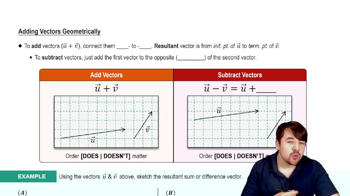
When an object moves in a medium with a current or wind, its actual velocity is the vector sum of its velocity relative to the medium and the velocity of the current. Understanding how to add vectors graphically or analytically is essential to find the resultant speed and direction.
Recommended video:
05:29
Adding Vectors Geometrically

Resolving Vectors into Components

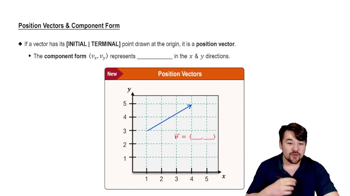
Breaking vectors into perpendicular components (usually horizontal and vertical) simplifies calculations. By resolving the boat's velocity and the current's velocity into components, one can apply algebraic methods to solve for unknown speeds and directions.
Recommended video:
03:55
Position Vectors & Component Form

Trigonometric Direction Angles

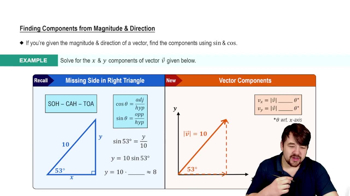
Directions like N 80° E are expressed using angles relative to cardinal points. Interpreting these angles correctly and converting them into standard coordinate angles is crucial for setting up the problem and applying trigonometric functions to find vector components.
Recommended video:
04:55
Finding Components from Direction and Magnitude