In Exercises 21–28, an object moves in simple harmonic motion described by the given equation, where t is measured in seconds and d in inches. In each exercise, find the following: a. the maximum displacement b. the frequency c. the time required for one cycle. d = −8 cos π/2 t
Table of contents
- 0. Review of College Algebra4h 45m
- 1. Measuring Angles40m
- 2. Trigonometric Functions on Right Triangles2h 5m
- 3. Unit Circle1h 19m
- 4. Graphing Trigonometric Functions1h 19m
- 5. Inverse Trigonometric Functions and Basic Trigonometric Equations1h 41m
- 6. Trigonometric Identities and More Equations2h 34m
- 7. Non-Right Triangles1h 38m
- 8. Vectors2h 25m
- 9. Polar Equations2h 5m
- 10. Parametric Equations1h 6m
- 11. Graphing Complex Numbers1h 7m
4. Graphing Trigonometric Functions
Graphs of the Sine and Cosine Functions
Multiple Choice
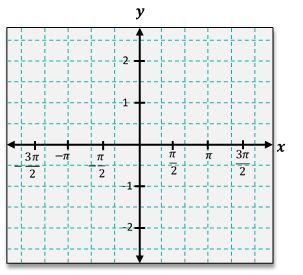
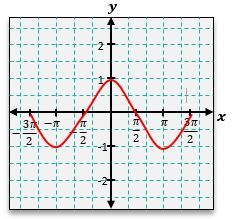
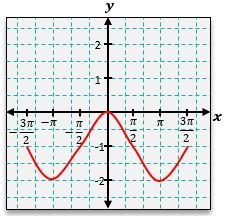
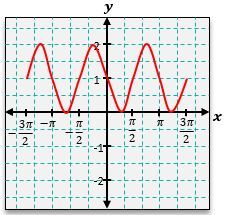
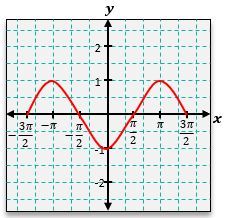
Sketch the function y=cos(x)−1 on the graph below.

A
B
C
D
0 Comments
Verified step by step guidance1
Start by understanding the function y = \(\cos\)(x) - 1. This is a transformation of the basic cosine function y = \(\cos\)(x).
The transformation involves a vertical shift downward by 1 unit. This means that every point on the graph of y = \(\cos\)(x) will be moved down by 1 unit.
Recall that the cosine function y = \(\cos\)(x) has a maximum value of 1 and a minimum value of -1. With the transformation y = \(\cos\)(x) - 1, the maximum value becomes 0 and the minimum value becomes -2.
The period of the cosine function is 2\(\pi\), meaning it repeats every 2\(\pi\) units along the x-axis. This property remains unchanged in the transformed function y = \(\cos\)(x) - 1.
Sketch the graph by plotting key points: at x = 0, y = \(\cos\)(0) - 1 = 0; at x = \(\pi\)/2, y = \(\cos\)(\(\pi\)/2) - 1 = -1; at x = \(\pi\), y = \(\cos\)(\(\pi\)) - 1 = -2; and continue this pattern to complete the graph over the interval shown.
Related Videos
Related Practice
Textbook Question
761
views

