Ch. 2 - Graphs of the Trigonometric Functions; Inverse Trigonometric Functions
Blitzer - Trigonometry 3rd Edition
Blitzer3rd EditionTrigonometryISBN: 9780137316601Not the one you use?Change textbook
Chapter 2, Problem 26

In Exercises 21–28, an object moves in simple harmonic motion described by the given equation, where t is measured in seconds and d in inches. In each exercise, find the following: a. the maximum displacement b. the frequency c. the time required for one cycle. d = 1/3 sin 2t

Verified step by step guidance
1
Identify the given simple harmonic motion equation: \(d = \frac{1}{3} \sin 2t\), where \(d\) is displacement and \(t\) is time in seconds.
To find the maximum displacement, recognize that the amplitude of the sine function represents the maximum displacement. The amplitude is the coefficient in front of the sine function, which is \(\frac{1}{3}\) inches.
To find the frequency, recall that the general form of simple harmonic motion is \(d = A \sin(\omega t)\), where \(\omega\) is the angular frequency in radians per second. Here, \(\omega = 2\). Use the relationship between angular frequency and frequency: \(f = \frac{\omega}{2\pi}\).
To find the time required for one cycle (the period \(T\)), use the formula \(T = \frac{1}{f}\) or equivalently \(T = \frac{2\pi}{\omega}\). Since \(\omega = 2\), substitute this value to find \(T\).
Summarize the results: maximum displacement is the amplitude \(\frac{1}{3}\) inches, frequency is \(\frac{2}{2\pi}\) Hz, and period is \(\frac{2\pi}{2}\) seconds.

Verified video answer for a similar problem:

This video solution was recommended by our tutors as helpful for the problem above.
Video duration:
3m
Was this helpful?

Key Concepts

Here are the essential concepts you must grasp in order to answer the question correctly.

Simple Harmonic Motion (SHM)

Simple Harmonic Motion describes oscillatory motion where the restoring force is proportional to displacement and acts in the opposite direction. The displacement varies sinusoidally with time, typically expressed as d(t) = A sin(ωt + φ), where A is amplitude, ω is angular frequency, and φ is phase shift.
Recommended video:
04:46
Products of Complex Numbers in Polar Form

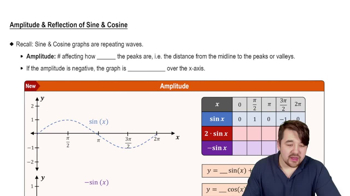
Amplitude and Maximum Displacement

Amplitude is the maximum displacement from the equilibrium position in SHM. It represents the peak value of the sinusoidal function and determines how far the object moves from its central position. In the equation d = (1/3) sin 2t, the amplitude is 1/3 inches.
Recommended video:
5:05
Amplitude and Reflection of Sine and Cosine

Frequency and Period of Oscillation

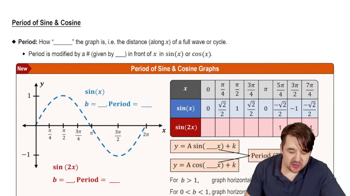
Frequency is the number of complete cycles per second, measured in Hertz (Hz), and is related to angular frequency ω by f = ω/(2π). The period is the time for one full cycle, given by T = 1/f. For d = (1/3) sin 2t, ω = 2, so frequency and period can be calculated accordingly.
Recommended video:
5:33
Period of Sine and Cosine Functions