Identify the function to be graphed: \(y = \frac{1}{2} \sin x + \cos x\) over the interval \(0 \leq x \leq 2\pi\).
Recall that the function is a sum of sine and cosine terms. To simplify the graphing process, express it as a single sinusoidal function using the identity: \(a \sin x + b \cos x = R \sin(x + \alpha)\), where \(R = \sqrt{a^2 + b^2}\) and \(\alpha = \arctan\left(\frac{b}{a}\right)\).
Rewrite the function as \(y = R \sin(x + \alpha) = \frac{\sqrt{5}}{2} \sin(x + \arctan(2))\). This form makes it easier to identify amplitude, phase shift, and period.
Use the rewritten function to plot key points: start by plotting the phase shift \(-\alpha\), then mark the maximum and minimum values at \(y = \pm R\), and complete the graph over one full period \(0 \leq x \leq 2\pi\).
Verified video answer for a similar problem:
This video solution was recommended by our tutors as helpful for the problem above
Video duration:
6m
Play a video:
0 Comments
Key Concepts
Here are the essential concepts you must grasp in order to answer the question correctly.
Graphing Trigonometric Functions
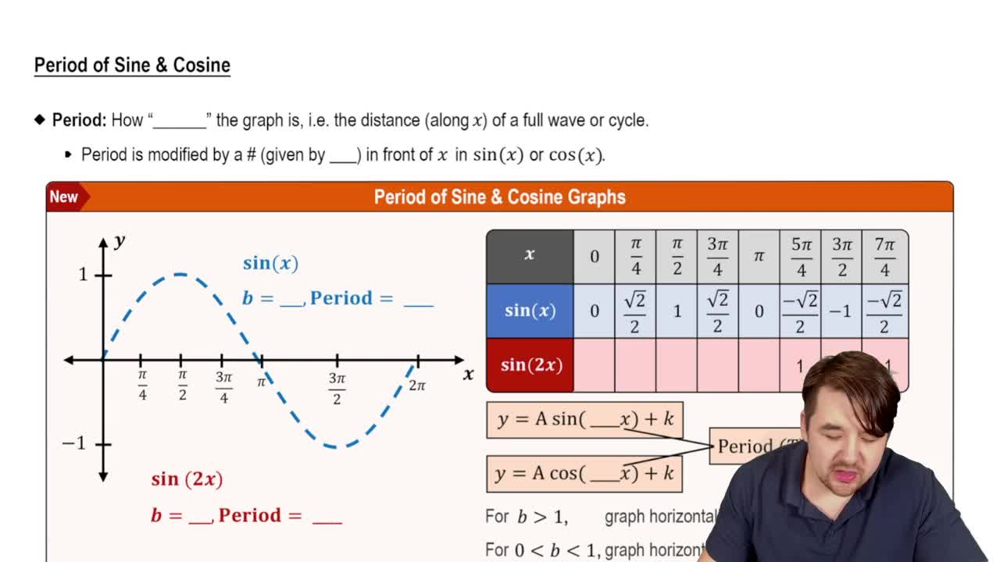
Graphing trigonometric functions involves plotting their values over a specified interval. Understanding the shape, period, amplitude, and phase shift of sine and cosine functions helps in sketching accurate graphs. For combined functions like y = 1/2 sin x + cos x, analyzing how the components interact is essential.
Amplitude is the maximum value a trigonometric function attains from its midline, while the period is the length of one complete cycle. For sine and cosine, the standard period is 2π. When functions are combined, the resulting amplitude and period may change, requiring techniques like rewriting the expression to identify these properties.
Using Trigonometric Identities to Simplify Expressions
Trigonometric identities allow rewriting sums of sine and cosine into a single trigonometric function with amplitude and phase shift, such as R sin(x + α). This simplification aids in graphing by making it easier to determine key features like maximum, minimum, and zeros of the function.

 6:07 minutes
 Verified step by step guidance
 6:04
6:04