Ch. 1 - Angles and the Trigonometric Functions
Blitzer - Trigonometry 3rd Edition
Blitzer3rd EditionTrigonometryISBN: 9780137316601Not the one you use?Change textbook
Chapter 1, Problem 36

Find a cofunction with the same value as the given expression.
tan (𝜋/7)

Verified step by step guidance
1
Recall the cofunction identity for tangent: \( \tan(\theta) = \cot\left(\frac{\pi}{2} - \theta\right) \). This means the tangent of an angle is equal to the cotangent of its complement.
Identify the given angle \( \theta = \frac{\pi}{7} \). We want to find a cofunction expression that has the same value as \( \tan\left(\frac{\pi}{7}\right) \).
Calculate the complementary angle for the cofunction by subtracting \( \theta \) from \( \frac{\pi}{2} \): \( \frac{\pi}{2} - \frac{\pi}{7} \).
Simplify the complementary angle: find a common denominator and subtract the fractions to get \( \frac{7\pi}{14} - \frac{2\pi}{14} = \frac{5\pi}{14} \).
Write the cofunction expression using the cotangent function: \( \tan\left(\frac{\pi}{7}\right) = \cot\left(\frac{5\pi}{14}\right) \).

Verified video answer for a similar problem:

This video solution was recommended by our tutors as helpful for the problem above.
Video duration:
2m
Was this helpful?

Key Concepts

Here are the essential concepts you must grasp in order to answer the question correctly.

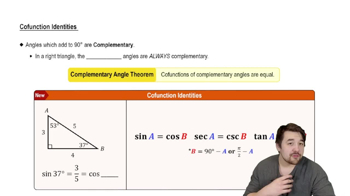
Cofunction Identities

Cofunction identities relate trigonometric functions of complementary angles, such as sin(θ) = cos(π/2 - θ) and tan(θ) = cot(π/2 - θ). These identities allow expressing one function in terms of another evaluated at the complementary angle.
Recommended video:
6:30
Cofunction Identities

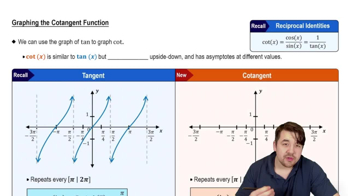
Tangent and Cotangent Relationship

Tangent and cotangent are reciprocal functions: tan(θ) = 1/cot(θ). Using cofunction identities, tan(θ) can be expressed as cot(π/2 - θ), which helps find equivalent expressions involving complementary angles.
Recommended video:
5:37
Introduction to Cotangent Graph

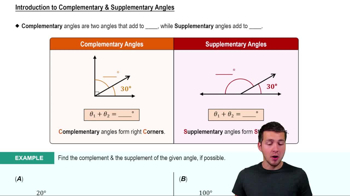
Radian Measure and Angle Complementarity

Angles in trigonometry are often measured in radians, where π radians equal 180 degrees. Complementary angles sum to π/2 radians (90 degrees), a key concept when applying cofunction identities to find equivalent trigonometric values.
Recommended video:
3:35
Intro to Complementary & Supplementary Angles