Simplify each expression. See Example 4. 1 - 2 sin² 22 ½°
Verified step by step guidance
1
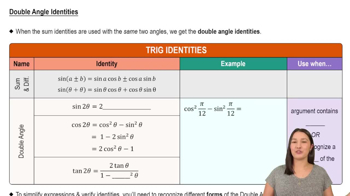
Recognize that the expression is in the form of a trigonometric identity. Specifically, it resembles the identity for the cosine of a double angle: \( \cos(2\theta) = 1 - 2\sin^2(\theta) \).
Identify \( \theta \) in the expression. Here, \( \theta = 22.5^\circ \).
Calculate the angle: \( 2 \times 22.5^\circ = 45^\circ \).
Substitute back into the expression: \( \cos(45^\circ) \).
Verified video answer for a similar problem:
This video solution was recommended by our tutors as helpful for the problem above
Play a video:
0 Comments
Key Concepts
Here are the essential concepts you must grasp in order to answer the question correctly.
Pythagorean Identity
The Pythagorean identity states that for any angle θ, sin²(θ) + cos²(θ) = 1. This fundamental relationship allows us to express one trigonometric function in terms of another, which is essential for simplifying expressions involving sine and cosine.
Double angle formulas provide relationships for trigonometric functions of double angles, such as sin(2θ) = 2sin(θ)cos(θ) and cos(2θ) = cos²(θ) - sin²(θ). These formulas can be useful in simplifying expressions that involve angles that are multiples of a given angle.
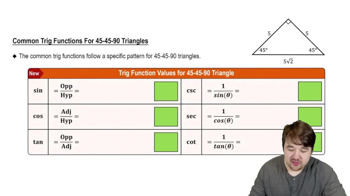
Certain angles, such as 0°, 30°, 45°, 60°, and 90°, have known sine and cosine values. For example, sin(30°) = 1/2 and cos(30°) = √3/2. Knowing these values can help in simplifying expressions involving trigonometric functions at these specific angles.

 Verified step by step guidance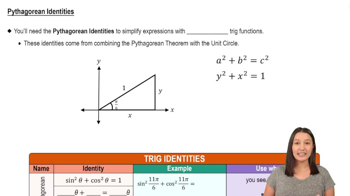
 6:25
6:25