Simplify each expression. sin 158.2°/(1 + cos 158.2°)
Verified step by step guidance
1
Recognize that the expression \( \frac{\sin 158.2^\circ}{1 + \cos 158.2^\circ} \) can be simplified using trigonometric identities.
Use the identity \( \sin(\theta) = \sin(180^\circ - \theta) \) to rewrite \( \sin 158.2^\circ \) as \( \sin(180^\circ - 158.2^\circ) = \sin 21.8^\circ \).
Similarly, use the identity \( \cos(\theta) = -\cos(180^\circ - \theta) \) to rewrite \( \cos 158.2^\circ \) as \( -\cos 21.8^\circ \).
Substitute these identities into the original expression to get \( \frac{\sin 21.8^\circ}{1 - \cos 21.8^\circ} \).
Recognize that this expression can be further simplified using the identity \( \tan\left(\frac{\theta}{2}\right) = \frac{\sin \theta}{1 + \cos \theta} \) to find a more simplified form.
Verified video answer for a similar problem:
This video solution was recommended by our tutors as helpful for the problem above
Play a video:
0 Comments
Key Concepts
Here are the essential concepts you must grasp in order to answer the question correctly.
Trigonometric Functions
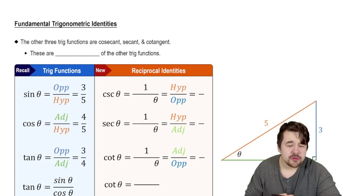
Trigonometric functions, such as sine and cosine, relate angles to ratios of sides in right triangles. The sine function, for example, gives the ratio of the length of the opposite side to the hypotenuse. Understanding these functions is essential for simplifying expressions involving angles, as they provide the foundational relationships needed to manipulate and evaluate trigonometric expressions.
Angles can be classified based on their measures, and certain properties apply to specific angle ranges. For instance, angles in the second quadrant (90° to 180°) have specific sine and cosine values. Recognizing that 158.2° is in the second quadrant helps in understanding the signs and values of sine and cosine, which is crucial for simplifying the given expression.
Trigonometric identities are equations that hold true for all values of the variables involved. Key identities, such as the Pythagorean identity and the sum-to-product identities, can simplify complex trigonometric expressions. In the context of the given expression, knowing how to apply these identities can facilitate the simplification process, making it easier to manipulate and evaluate the expression.

 Verified step by step guidance
 6:04
6:04