Simplify each expression. Assume all variables represent nonzero real numbers. See Examples 2 and 3. -(4m³n⁰)²
Table of contents
- 0. Review of College Algebra4h 45m
- 1. Measuring Angles40m
- 2. Trigonometric Functions on Right Triangles2h 5m
- 3. Unit Circle1h 19m
- 4. Graphing Trigonometric Functions1h 19m
- 5. Inverse Trigonometric Functions and Basic Trigonometric Equations1h 41m
- 6. Trigonometric Identities and More Equations2h 34m
- 7. Non-Right Triangles1h 38m
- 8. Vectors2h 25m
- 9. Polar Equations2h 5m
- 10. Parametric Equations1h 6m
- 11. Graphing Complex Numbers1h 7m
0. Review of College Algebra
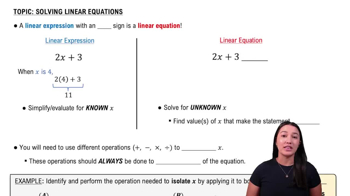
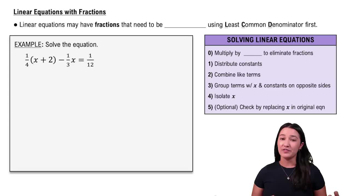
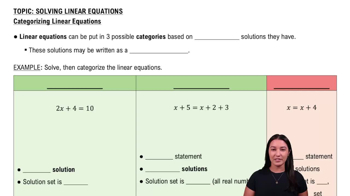
Solving Linear Equations
Problem R.3.35
Textbook Question
Match each expression in Column I with its equivalent in Column II. See Example 3. I II. a. 6° A. 0 b. -6° B. 1 c. (-6)° C. -1 d. -(-6)° D. 6 E. -6
Verified step by step guidance1
Understand that the expressions in Column I represent angles or values related to angles, and the goal is to match them with their equivalent values or simplified forms in Column II.
Recognize that the notation like '6°' or '-6°' refers to angles measured in degrees, while expressions like '-(-6)°' involve simplifying the double negative sign.
Simplify each expression in Column I: for example, '-(-6)°' simplifies to '6°' because the double negative cancels out.
Match each simplified expression from Column I to the corresponding value in Column II by comparing their numerical or algebraic equivalence.
Verify each match by considering the sign and value carefully to ensure the correct pairing between the expressions and their equivalents.
Verified video answer for a similar problem:This video solution was recommended by our tutors as helpful for the problem above
Video duration:
1mPlay a video:
0 Comments
Key Concepts
Here are the essential concepts you must grasp in order to answer the question correctly.
Degree Measure and Angle Notation
Degrees are units used to measure angles, where 360° represents a full rotation. The notation like 6° or -6° indicates the size and direction of the angle, with negative angles typically representing clockwise rotation. Understanding how to interpret these angle measures is essential for matching equivalent expressions.
Recommended video:
i & j Notation
Negative Angles and Double Negation
A negative angle means rotation in the opposite direction, and applying a negative sign twice, as in -(-6)°, returns the original positive angle. Recognizing how negation affects angle values helps in simplifying expressions and finding their equivalents.
Recommended video:
Double Angle Identities
Equivalence of Expressions and Simplification
Matching expressions requires simplifying or evaluating each term to its simplest form or numerical equivalent. This involves understanding how operations like negation and parentheses affect the value, enabling correct pairing between expressions in different forms.
Recommended video:
Simplifying Trig Expressions
Related Videos
Related Practice
Textbook Question
445
views