Simplify each expression. Assume all variables represent nonzero real numbers. See Examples 2 and 3. - ( x³y⁵/z)⁰
Verified step by step guidance
1
Recall the zero exponent rule: for any nonzero expression \(a\), \(a^0 = 1\). This means that any expression raised to the power of zero simplifies to 1.
Identify the expression inside the parentheses: \(\left( \frac{x^3 y^5}{z} \right)^0\). Since the entire fraction is raised to the zero power, the value of this expression is 1 regardless of the values of \(x\), \(y\), and \(z\) (as long as they are nonzero).
Rewrite the original expression using this simplification: \(x^3 y^5 - 1\).
Since the problem asks to simplify the expression, note that no further simplification is possible because \(x^3 y^5\) and 1 are unlike terms and cannot be combined.
Therefore, the simplified form of the expression is \(x^3 y^5 - 1\).
Verified video answer for a similar problem:
This video solution was recommended by our tutors as helpful for the problem above
Video duration:
1m
Play a video:
0 Comments
Key Concepts
Here are the essential concepts you must grasp in order to answer the question correctly.
Zero Exponent Rule
Any nonzero base raised to the zero power equals 1. This means that for any expression (A)⁰, where A ≠ 0, the value simplifies directly to 1 regardless of A's complexity.
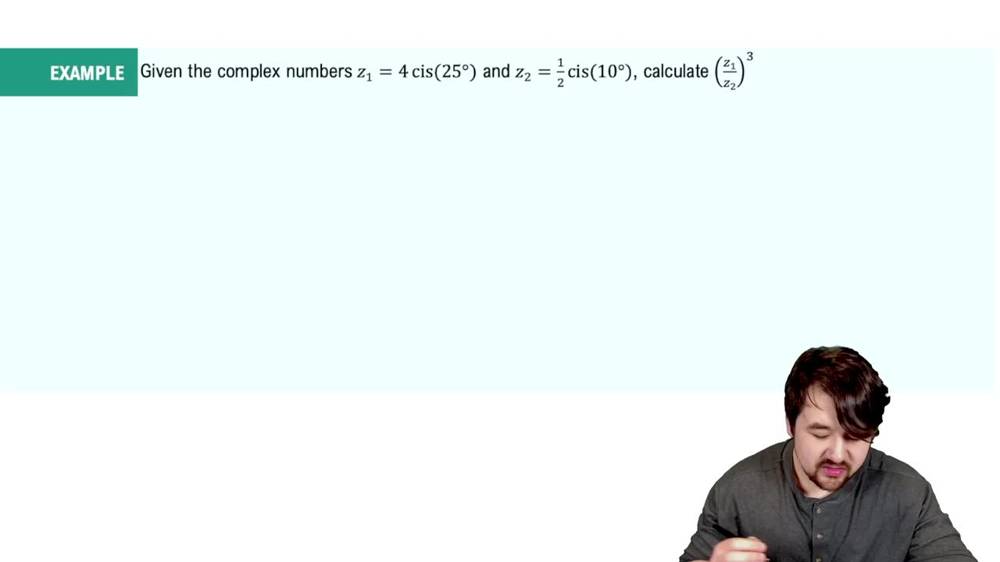
Powers Of Complex Numbers In Polar Form (DeMoivre's Theorem) Example 1
Properties of Exponents
Exponents indicate repeated multiplication. When simplifying expressions with exponents, rules such as product, quotient, and power of a power help combine or reduce terms efficiently.
Simplifying involves reducing expressions to their simplest form by applying arithmetic and algebraic rules, including combining like terms and applying exponent rules, to make expressions easier to interpret or solve.

 1:36 minutes
 Verified step by step guidance
 03:05
03:05