Use trigonometric function values of quadrantal angles to evaluate each expression. (sec 180°)² ― 3 (sin 360°)² + cos 180°
Verified step by step guidance
1
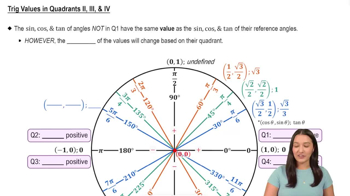
Recall the definitions and values of trigonometric functions at quadrantal angles: 180° and 360°. For example, \( \cos 180^\circ = -1 \), \( \sin 360^\circ = 0 \), and \( \sec 180^\circ = \frac{1}{\cos 180^\circ} \).
Calculate \( \sec 180^\circ \) by taking the reciprocal of \( \cos 180^\circ \). Since \( \cos 180^\circ = -1 \), then \( \sec 180^\circ = \frac{1}{-1} = -1 \).
Square the value of \( \sec 180^\circ \) to get \( (\sec 180^\circ)^2 \). This means calculating \( (-1)^2 \).
Calculate \( (\sin 360^\circ)^2 \) by squaring the sine of 360°, which is \( 0^2 \). Then multiply this result by 3 as indicated in the expression.
Substitute all the calculated values back into the original expression \( (\sec 180^\circ)^2 - 3 (\sin 360^\circ)^2 + \cos 180^\circ \) and simplify step-by-step to evaluate the entire expression.
Verified video answer for a similar problem:
This video solution was recommended by our tutors as helpful for the problem above
Video duration:
2m
Play a video:
0 Comments
Key Concepts
Here are the essential concepts you must grasp in order to answer the question correctly.
Quadrantal Angles
Quadrantal angles are angles that lie on the x- or y-axis of the coordinate plane, typically 0°, 90°, 180°, 270°, and 360°. Their trigonometric function values are special and often take values of 0, ±1, or undefined, simplifying calculations.
Trigonometric Function Values at Quadrantal Angles
At quadrantal angles, sine, cosine, and secant functions have specific values: for example, sin 360° = 0, cos 180° = -1, and sec 180° = 1/cos 180° = -1. Knowing these exact values helps directly evaluate expressions without approximation.
Evaluating Expressions Using Trigonometric Identities
To evaluate expressions involving trigonometric functions, substitute known values and apply algebraic operations carefully. For example, squaring sec 180° means squaring its value, and combining terms requires attention to signs and coefficients.

 2:32 minutes
 Verified step by step guidance
 6:36
6:36