
If n is an integer, n • 180° represents an integer multiple of 180°, (2n + 1) • 90° represents an odd integer multiple of 90° , and so on. Determine whether each expression is equal to 0, 1, or ―1, or is undefined. sin[n • 180°]
Ch. 1 - Trigonometric Functions
Chapter 2, Problem 102
If n is an integer, n • 180° represents an integer multiple of 180°, (2n + 1) • 90° represents an odd integer multiple of 90° , and so on. Determine whether each expression is equal to 0, 1, or ―1, or is undefined. sin[270° + n • 360°]
Verified step by step guidance1
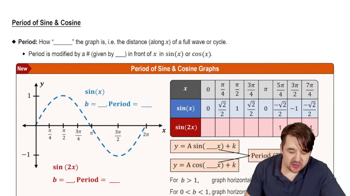
Recognize that the expression inside the sine function is \(270° + n \cdot 360°\), where \(n\) is an integer. Since \$360°$ represents a full rotation, adding \(n \cdot 360°\) does not change the sine value due to the periodicity of the sine function.
Recall the periodicity property of sine: \(\sin(\theta + 360°) = \sin(\theta)\) for any angle \(\theta\). Therefore, \(\sin(270° + n \cdot 360°) = \sin(270°)\).
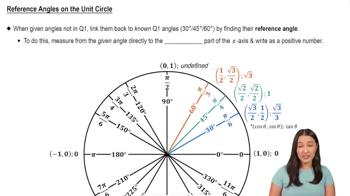
Evaluate \(\sin(270°)\). Using the unit circle, \$270°\( corresponds to the point \)(0, -1)$, so \(\sin(270°) = -1\).
Conclude that for any integer \(n\), \(\sin(270° + n \cdot 360°) = -1\).
Therefore, the expression is equal to \(-1\) for all integer values of \(n\).

Verified video answer for a similar problem:
This video solution was recommended by our tutors as helpful for the problem above.
Video duration:
2mWas this helpful?
Key Concepts
Here are the essential concepts you must grasp in order to answer the question correctly.
Periodic Properties of the Sine Function
The sine function is periodic with a period of 360°, meaning sin(θ + 360°) = sin(θ) for any angle θ. This property allows simplification of expressions involving angles plus multiples of 360°, reducing them to equivalent angles within one full rotation.
Recommended video:
Period of Sine and Cosine Functions
Reference Angles and Quadrant Sign Determination
The value of sine depends on the angle's position in the unit circle. Angles like 270° correspond to specific points where sine takes values -1, 0, or 1. Understanding which quadrant or axis the angle lies on helps determine the sine value's sign and magnitude.
Recommended video:
Reference Angles on the Unit Circle
Evaluating Sine at Standard Angles
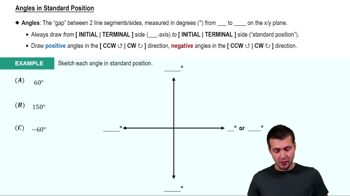
Certain angles such as 0°, 90°, 180°, 270°, and 360° have known sine values (0, 1, 0, -1, 0 respectively). Recognizing these standard angles allows direct evaluation of sine expressions without complex calculations.
Recommended video:
Drawing Angles in Standard Position
Related Practice
Textbook Question
591
views
Textbook Question
Concept Check Suppose that ―90° < θ < 90° . Find the sign of each function value.
sec(―θ)
531
views
Textbook Question
Concept Check Suppose that ―90° < θ < 90° . Find the sign of each function value. cos(θ―180°)
641
views
Textbook Question
Give two positive and two negative angles that are coterminal with the given quadrantal angle. 270°
792
views
Textbook Question
If n is an integer, n • 180° represents an integer multiple of 180°, (2n + 1) • 90° represents an odd integer multiple of 90° , and so on. Determine whether each expression is equal to 0, 1, or ―1, or is undefined. cot[n • 180°]
577
views
Textbook Question
Write an expression that generates all angles coterminal with each angle. Let n represent any integer. 135°
572
views
