Concept Check Suppose that 90° < θ < 180° . Find the sign of each function value. cot (θ + 180°)
Verified step by step guidance
1
Recall the given range for \( \theta \): \( 90^\circ < \theta < 180^\circ \). This means \( \theta \) is in the second quadrant.
Understand the angle transformation: \( \theta + 180^\circ \) shifts the angle by 180 degrees, moving it to the third quadrant because adding 180° moves any angle to the opposite side of the unit circle.
Recall the definition of the cotangent function: \( \cot \alpha = \frac{\cos \alpha}{\sin \alpha} \). The sign of \( \cot \alpha \) depends on the signs of \( \cos \alpha \) and \( \sin \alpha \).
Determine the signs of sine and cosine in the third quadrant: both \( \sin \alpha \) and \( \cos \alpha \) are negative in the third quadrant.
Since both sine and cosine are negative in the third quadrant, their ratio (cotangent) is positive because a negative divided by a negative is positive. Therefore, \( \cot (\theta + 180^\circ) \) is positive.
Verified video answer for a similar problem:
This video solution was recommended by our tutors as helpful for the problem above
Video duration:
3m
Play a video:
0 Comments
Key Concepts
Here are the essential concepts you must grasp in order to answer the question correctly.
Trigonometric Function Signs in Different Quadrants
The sign of trigonometric functions depends on the quadrant of the angle. For 90° < θ < 180°, θ lies in the second quadrant where sine is positive, cosine and tangent are negative. Understanding these sign rules helps determine the sign of functions like cotangent for given angles.
Cotangent Function and Its Relationship to Tangent
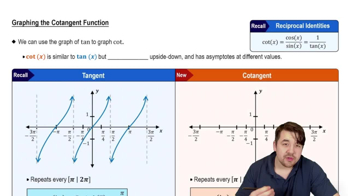
Cotangent is the reciprocal of tangent, defined as cot(θ) = 1/tan(θ). Since tangent is sine divided by cosine, cotangent shares the same sign as cosine divided by sine. Knowing this relationship aids in finding the sign of cotangent values based on sine and cosine signs.
Angle Addition and Periodicity of Trigonometric Functions
Adding 180° to an angle shifts it by half a full rotation, affecting the function's value. Cotangent has a period of 180°, so cot(θ + 180°) = cot(θ). This periodicity means the sign of cot(θ + 180°) is the same as cot(θ), simplifying the sign determination.