Determine whether each statement is possible or impossible. a. sec θ = ―2/3
Verified step by step guidance
1
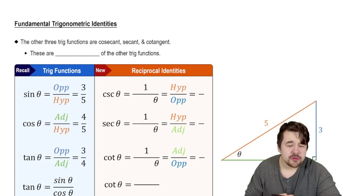
Recall the definition of secant: \(\sec \theta = \frac{1}{\cos \theta}\). This means that \(\sec \theta\) is the reciprocal of \(\cos \theta\).
Since \(\cos \theta\) ranges between \(-1\) and \$1$ for all real values of \(\theta\), the values of \(\sec \theta\) must satisfy \(|\sec \theta| \geq 1\) or be undefined where \(\cos \theta = 0\).
Check the given value \(\sec \theta = -\frac{2}{3}\). The absolute value is \(\left| -\frac{2}{3} \right| = \frac{2}{3}\), which is less than 1.
Because \(|\sec \theta|\) must be greater than or equal to 1, \(\sec \theta = -\frac{2}{3}\) is not possible for any real angle \(\theta\).
Therefore, the statement \(\sec \theta = -\frac{2}{3}\) is impossible.
Verified video answer for a similar problem:
This video solution was recommended by our tutors as helpful for the problem above
Video duration:
1m
Play a video:
0 Comments
Key Concepts
Here are the essential concepts you must grasp in order to answer the question correctly.
Definition and Range of Secant Function
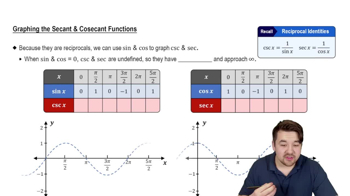
The secant function, sec θ, is defined as the reciprocal of the cosine function: sec θ = 1/cos θ. Since cosine values range between -1 and 1, secant values are either greater than or equal to 1 or less than or equal to -1. Values between -1 and 1 are not possible for sec θ.
Because sec θ = 1/cos θ, if sec θ is given, the corresponding cosine value can be found by taking its reciprocal. This relationship helps determine if a given secant value is possible by checking if the reciprocal lies within the cosine function's valid range.
To determine if a trigonometric value is possible, compare it against the function's range. For sec θ, values must satisfy |sec θ| ≥ 1. If a given value falls outside this range, it is impossible for any angle θ to produce that value.