Determine whether each statement is possible or impossible. a. sec θ = ―2/3
Verified step by step guidance
1
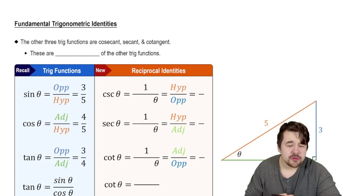
Recall that the secant function, \( \sec \theta \), is the reciprocal of the cosine function, \( \cos \theta \). Therefore, \( \sec \theta = \frac{1}{\cos \theta} \).
Given \( \sec \theta = -\frac{2}{3} \), this implies \( \cos \theta = -\frac{3}{2} \).
The range of the cosine function is \([-1, 1]\), meaning \( \cos \theta \) can only take values within this interval.
Since \(-\frac{3}{2}\) is outside the range of \([-1, 1]\), it is impossible for \( \cos \theta \) to equal \(-\frac{3}{2}\).
Therefore, the statement \( \sec \theta = -\frac{2}{3} \) is impossible.
Verified video answer for a similar problem:
This video solution was recommended by our tutors as helpful for the problem above
Video duration:
1m
Play a video:
0 Comments
Key Concepts
Here are the essential concepts you must grasp in order to answer the question correctly.
Secant Function
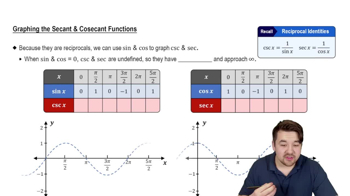
The secant function, denoted as sec(θ), is the reciprocal of the cosine function. It is defined as sec(θ) = 1/cos(θ). Since the cosine function can only take values between -1 and 1, the secant function will have values outside this range, specifically less than -1 or greater than 1.
The range of the secant function is important for determining the validity of sec(θ) values. Specifically, sec(θ) can take any value less than -1 or greater than 1. Therefore, a value like -2/3, which lies between -1 and 1, is not possible for sec(θ).
Trigonometric identities are equations involving trigonometric functions that hold true for all values of the variables. Understanding these identities helps in analyzing the relationships between different trigonometric functions, such as how sec(θ) relates to cos(θ). This knowledge is crucial for determining the feasibility of given trigonometric statements.